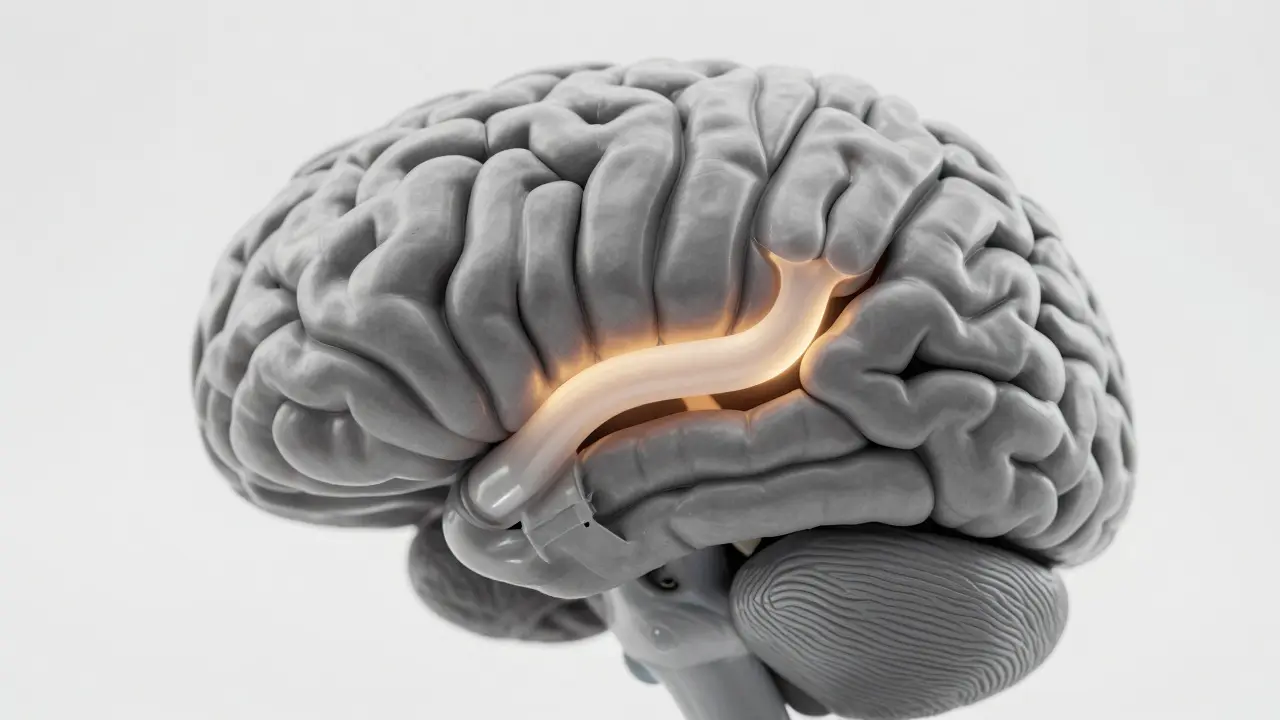
Ever made a mistake at work and felt that immediate jolt of regret? Or stood in front of two options, paralyzed by the fear of picking the wrong one? That split-second tension isn't just in your head-it’s happening in a specific part of your brain called the Anterior Cingulate Cortex. This region acts as your internal alarm system, detecting when things go wrong and helping you decide what to do next. Understanding how this area works can explain why some people bounce back from mistakes faster than others, or why high-stakes decisions feel so draining.
What Exactly Is the Anterior Cingulate Cortex?
The Anterior Cingulate Cortex, often abbreviated as ACC, is a strip of gray matter located deep within the frontal lobe of the brain. It sits right above the corpus callosum, the bridge connecting the left and right hemispheres. While it looks like a simple band of tissue, its job is complex. The ACC doesn't store memories or process visual images directly. Instead, it monitors performance. Think of it as a quality control inspector on an assembly line. It watches your actions, compares them to your goals, and flags any discrepancies.
Neuroscientists divide the ACC into two main functional areas. The dorsal anterior cingulate cortex (dACC) handles cognitive control, focusing on logic, conflict resolution, and error detection. The rostral anterior cingulate cortex (rACC), also known as the subgenual ACC, is more involved in emotional regulation and motivation. When you make a calculation error, the dACC lights up. When you feel sad about that error, the rACC takes over. Both parts work together to keep you on track.
How Error Processing Works in Real Time
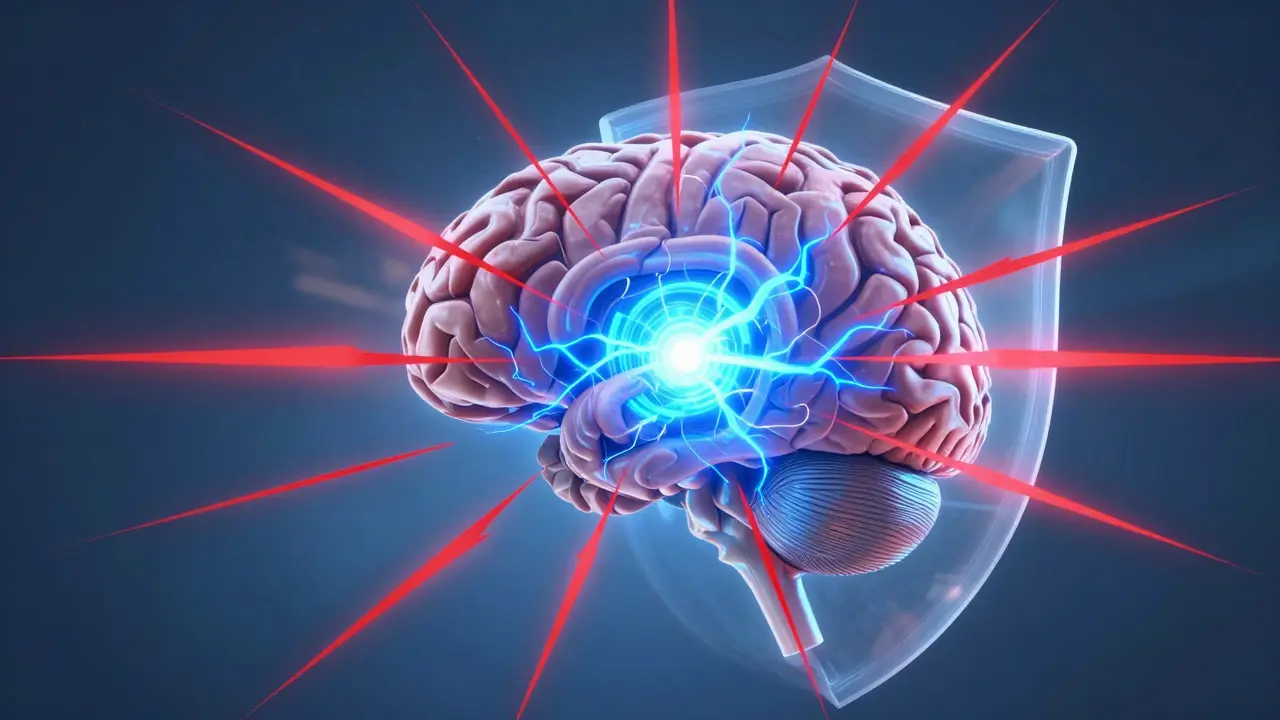
Error processing is one of the ACC's most well-documented functions. When you commit a mistake-like pressing the wrong key on a keyboard-the brain generates a specific electrical signal called the Error-Related Negativity (ERN). This signal peaks about 100 milliseconds after the error occurs. The ACC is the primary generator of this ERN. It detects the mismatch between what you intended to do and what actually happened.
This detection triggers a cascade of effects. First, your reaction time slows down for the next few seconds. This is a protective mechanism. By slowing down, your brain gives itself more time to process information carefully, reducing the chance of repeating the same mistake. Second, your attention sharpens. You become hyper-aware of the task at hand. If you’ve ever noticed yourself double-checking your work after a small slip-up, that’s the ACC at work. It’s essentially saying, "Pay closer attention now; we just messed up."
However, not all errors are treated equally. The intensity of the ACC's response depends on the significance of the error. A minor typo might trigger a weak signal, while missing a critical deadline could trigger a massive activation. This scaling allows the brain to allocate resources efficiently. You don’t need the same level of alertness for every single hiccup, only for the ones that matter.
The Role in Decision Making Under Uncertainty
Mistakes aren't the only thing the ACC handles. It plays a crucial role in decision making, especially when choices are difficult or ambiguous. Imagine you’re choosing between two job offers. One pays more but has longer hours. The other pays less but offers better work-life balance. There is no objectively "right" answer. This is where the ACC shines. It evaluates the potential outcomes of each choice and weighs the risks against the rewards.
When facing conflicting cues-such as when two different pieces of information suggest opposite actions-the ACC helps resolve the conflict. For example, if you see a stop sign but hear a car horn urging you to go, your brain experiences conflict. The ACC helps suppress the impulse to move and reinforces the decision to stop. This process is known as conflict monitoring. The stronger the conflict, the more active the ACC becomes.
Furthermore, the ACC influences how much effort you’re willing to exert. If a decision requires significant mental energy, the ACC assesses whether the potential reward is worth the cost. If the reward seems too low compared to the effort required, the ACC may signal disengagement. This explains why people sometimes give up on tasks that seem too hard or unrewarding. It’s not just laziness; it’s a biological calculation performed by your brain.
Differences in Individual Responses
Not everyone’s ACC works the same way. Individual differences in ACC activity can explain why some people are perfectionists while others are more laid-back. Research shows that individuals with higher baseline ACC activity tend to be more sensitive to errors. They notice mistakes quickly and adjust their behavior rapidly. These individuals often score higher on measures of conscientiousness and anxiety. On the flip side, those with lower ACC activity might miss subtle errors but remain calm under pressure.
This variation has practical implications. In professions requiring high precision, such as surgery or air traffic control, selecting candidates with robust ACC error-monitoring capabilities might be beneficial. Conversely, in creative fields where risk-taking is encouraged, a slightly less reactive ACC might allow for more experimental approaches without being hindered by fear of failure. Understanding these differences helps tailor training and support strategies to individual needs.
Common Misconceptions About the ACC
A common myth is that the ACC is solely responsible for emotions. While the rACC does play a role in mood regulation, the ACC is fundamentally a cognitive controller. It deals with logic, conflict, and performance monitoring first. Emotions come into play when the consequences of errors or decisions have personal value. Another misconception is that the ACC is static. In reality, it is highly plastic. With practice and experience, the ACC can learn to tune out irrelevant errors and focus on critical ones. This adaptability is key to skill acquisition. As you master a task, the ACC’s involvement decreases because the task becomes automatic, freeing up resources for more complex challenges.
| Subregion | Primary Function | Example Scenario |
|---|---|---|
| Dorsal ACC (dACC) | Cognitive control, error detection, conflict monitoring | Correcting a math error during an exam |
| Rostrol ACC (rACC) | Emotional regulation, motivation, social cognition | Feeling embarrassed after a public mistake |
Practical Implications for Daily Life
Knowing how the ACC works can help you manage stress and improve performance. Since the ACC slows down reaction times after errors, it’s important to build in buffers for tasks where accuracy is critical. If you know you’re prone to making mistakes under pressure, take short breaks to reset your cognitive state. Meditation and mindfulness practices have been shown to modulate ACC activity, potentially reducing the negative emotional impact of errors. By training your brain to view mistakes as data rather than failures, you can reduce the excessive activation of the rACC and keep the dACC focused on improvement.
Additionally, structuring your environment to minimize unnecessary conflicts can save mental energy. Cluttered workspaces or unclear instructions create constant low-level conflict, which drains the ACC’s capacity. Clear goals and organized workflows allow the ACC to focus on genuine problems rather than trivial distractions. This approach leads to better decision-making and fewer costly errors over time.
Frequently Asked Questions
Where exactly is the Anterior Cingulate Cortex located?
The Anterior Cingulate Cortex is located in the medial wall of the frontal lobe, situated above the corpus callosum. It spans from the front of the brain towards the center, playing a central role in linking cognitive and emotional processes.
Does the ACC only activate when I make a mistake?
No, the ACC activates during various cognitive tasks. It responds to errors, but also to conflicts, uncertainty, and the need for increased mental effort. It is constantly monitoring performance, even when no explicit mistake is made.
Can damage to the ACC affect personality?
Yes, damage to the ACC can lead to changes in behavior and personality. Patients may show reduced concern for errors, impulsivity, or apathy. Because the ACC links thought and emotion, injury here can disrupt both logical decision-making and emotional responsiveness.
How does the ACC relate to anxiety disorders?
Individuals with anxiety disorders often show heightened ACC activity, particularly in response to errors or social evaluation. This hyperactivity may contribute to the excessive worry and self-criticism characteristic of anxiety. Therapies aimed at regulating this response, such as cognitive behavioral therapy, can help normalize ACC function.
Is there a way to train my ACC to perform better?
While you can't directly "train" the ACC like a muscle, you can influence its function through habits. Engaging in tasks that require sustained attention, practicing mindfulness, and learning from mistakes without harsh self-judgment can help optimize how your ACC processes information and regulates effort.