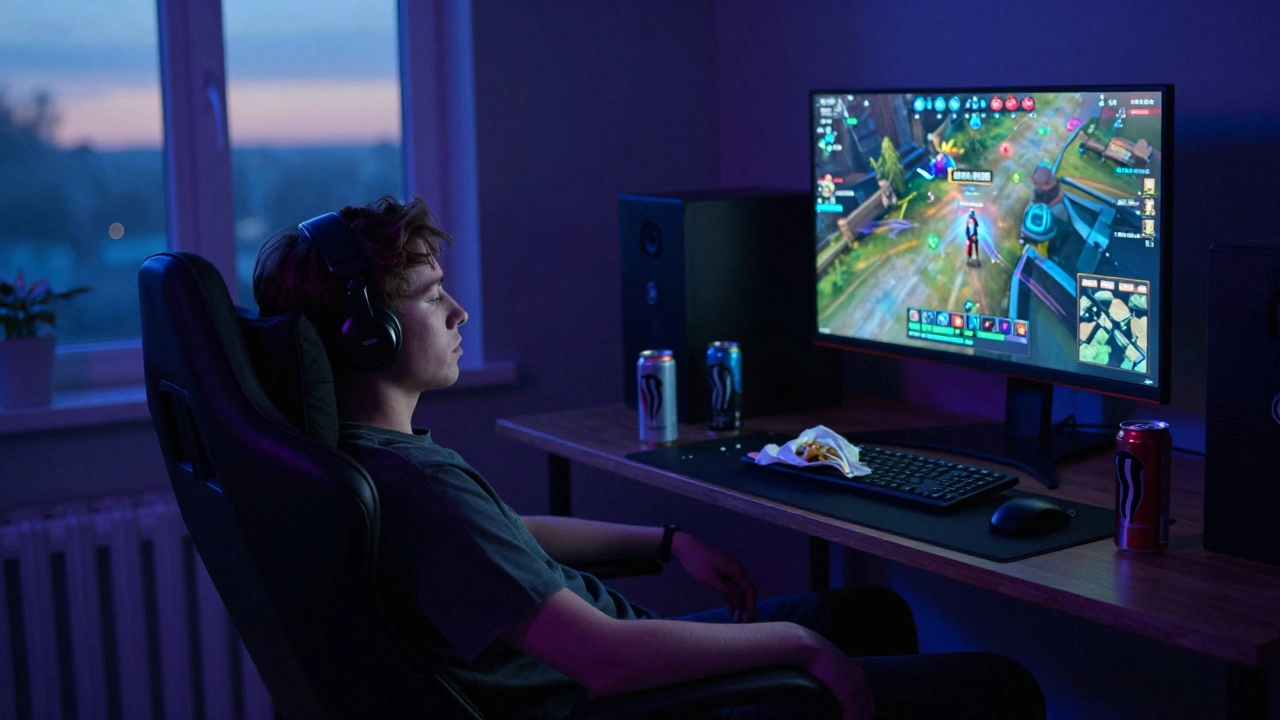
More than half a million people in Canada are struggling with gaming addiction. That’s not a guess. It’s based on data from Health Canada and peer-reviewed studies tracking behavioral patterns over the last five years. The numbers range from 470,400 to 720,000 individuals who meet clinical criteria for gaming disorder - a condition recognized by the World Health Organization since 2018. This isn’t just about playing too much. It’s about losing control over gaming to the point it damages relationships, jobs, health, and daily functioning.
What Does Gaming Addiction Actually Look Like in Canada?
Gaming addiction isn’t about how many hours someone plays. It’s about what happens when they can’t stop. In Canada, people with this disorder often skip meals, miss work or school, isolate from family, and lose sleep for weeks at a time. Some report playing 12 to 16 hours straight on weekends, then crashing for 12 hours straight afterward. Others quit jobs because they couldn’t manage shifts around their gaming schedule.
A 2024 study from the University of Toronto tracked 1,200 adults who self-reported compulsive gaming. Of those, 68% said they had tried to cut back and failed. Nearly half admitted to lying to loved ones about how much time they spent gaming. One in five reported losing more than $5,000 in a year on in-game purchases - not just for fun, but because they felt they had to keep playing to stay competitive or avoid withdrawal.
Who’s Most at Risk?
The myth that gaming addiction only affects teenagers is outdated. In Canada, the fastest-growing group is adults between 25 and 40. Why? Many use games as an escape from stress, loneliness, or depression. Online multiplayer games - especially ones with loot boxes, progression systems, and social pressure - are designed to keep players hooked.
Men make up about 70% of cases, but women are catching up fast. A 2025 survey by the Canadian Psychological Association found that 38% of women who met the criteria for gaming disorder reported using games to cope with anxiety or trauma. Indigenous youth, immigrants adjusting to life in Canada, and people with ADHD or autism are also at higher risk. For them, gaming isn’t just entertainment - it’s a safe space.

The Role of Game Design
Game companies don’t accidentally create addictive experiences. They hire behavioral psychologists to design systems that trigger dopamine spikes. Every win, every level-up, every rare item drop is timed to keep you coming back. Loot boxes, ranked modes, daily login rewards, and social leaderboards are all proven tools to increase engagement - and dependency.
In Canada, regulations are slow to catch up. While some provinces have banned loot boxes for minors, there’s no national law requiring games to disclose their odds or limit playtime. A 2023 report from the Canadian Centre on Substance Use and Addiction found that 82% of top-selling games in Canada use at least three addictive design elements. That’s higher than the global average.
Where People Turn for Help
Most Canadians with gaming addiction don’t go to a doctor. They feel ashamed. Or they think no one understands. But help is available - if you know where to look.
- Canadian Mental Health Association (CMHA) offers free online counseling and peer support groups for gaming disorder.
- Game Quitters is a Canadian-based nonprofit that runs virtual recovery programs modeled after AA - but for gaming.
- Telehealth services through provincial health plans now include behavioral therapy for digital addiction.
- University clinics in Vancouver, Toronto, and Montreal run research-based intervention programs with real-time usage tracking.
One program in Ontario tracked 200 participants over six months. Those who completed the full 12-week program saw a 65% reduction in daily playtime. Their sleep quality improved by 40%. Relationships with family members improved in 73% of cases.

Why This Is a Public Health Issue
When people stop gaming, they don’t just feel better - they start contributing again. They return to school. They get hired. They reconnect with friends. But right now, Canada doesn’t treat gaming addiction like other behavioral addictions. There’s no dedicated funding stream. No public awareness campaigns. No training for doctors.
Compare it to gambling addiction. In Canada, gambling disorder has government-funded treatment centers, public service ads, and even mandatory warning labels on slot machines. Gaming disorder? Nothing like that. A 2025 report from the Canadian Institute for Health Information found that only 12% of family doctors feel confident diagnosing gaming addiction - even though it’s in the ICD-11.
What Can Be Done?
Change starts with awareness. If you or someone you know is struggling:
- Track usage with apps like Digital Wellbeing (Android) or Screen Time (iOS). Set hard limits.
- Replace gaming time with structured activities - walking, cooking, volunteering, or joining a club.
- Don’t wait until things fall apart. Reach out to CMHA or Game Quitters before it gets worse.
- Advocate for policy change. Ask your MP to support legislation that requires game publishers to disclose addictive mechanics and limit microtransactions for minors.
Canada has the data. It has the resources. What it’s missing is the urgency. Half a million people aren’t just playing games. They’re losing pieces of their lives. And it doesn’t have to be that way.
Is gaming addiction officially recognized in Canada?
Yes. Canada follows the World Health Organization’s ICD-11, which includes "Gaming Disorder" as a diagnosable condition since 2018. It’s classified under "Disorders due to addictive behaviors." Health Canada recognizes it as a public health concern, though access to treatment varies by province.
How is gaming addiction different from just playing a lot?
Playing a lot doesn’t mean you’re addicted. Addiction means you lose control. If gaming interferes with your job, school, relationships, sleep, or health - and you can’t stop even when you want to - that’s the line. It’s not about hours. It’s about consequences. Someone who plays 8 hours a day but still works, eats, and connects with family isn’t addicted. Someone who skips meals, loses jobs, or isolates themselves because of gaming likely is.
Are loot boxes a major cause of gaming addiction in Canada?
Loot boxes aren’t the only cause, but they’re a major trigger. They mimic gambling mechanics - random rewards, variable reinforcement, and high stakes. A 2024 study in the Canadian Journal of Psychiatry found that people who spent more than $200/month on loot boxes were 4.3 times more likely to meet criteria for gaming disorder. Many provinces have restricted them for minors, but no national ban exists.
Can gaming addiction be treated successfully?
Yes. Cognitive behavioral therapy (CBT) has shown the best results in Canadian studies. Programs that combine therapy, usage tracking, and social support help over 60% of participants reduce compulsive play within 12 weeks. Recovery isn’t about quitting games forever - it’s about regaining control. Many people return to gaming in healthy, balanced ways after treatment.
Why don’t more doctors in Canada talk about gaming addiction?
Most doctors weren’t trained to recognize it. Medical schools in Canada don’t require coursework on behavioral addictions beyond substance use. Many physicians still think it’s just a "phase" or a "lifestyle choice." But as data piles up - with over half a million affected - that’s starting to change. Organizations like the Canadian Psychiatric Association are pushing for updated training guidelines.