
You know that feeling. You’re three hours into a session of League of Legends, a popular multiplayer online battle arena game, or you’ve just hit a new rank in Call of Duty. You feel electric, focused, and strangely alive. But when you finally close the laptop, your hands shake slightly, and the real world feels dull by comparison. Why does this happen? It’s not just "being addicted" in a vague sense. Specific hardware in your brain is firing.
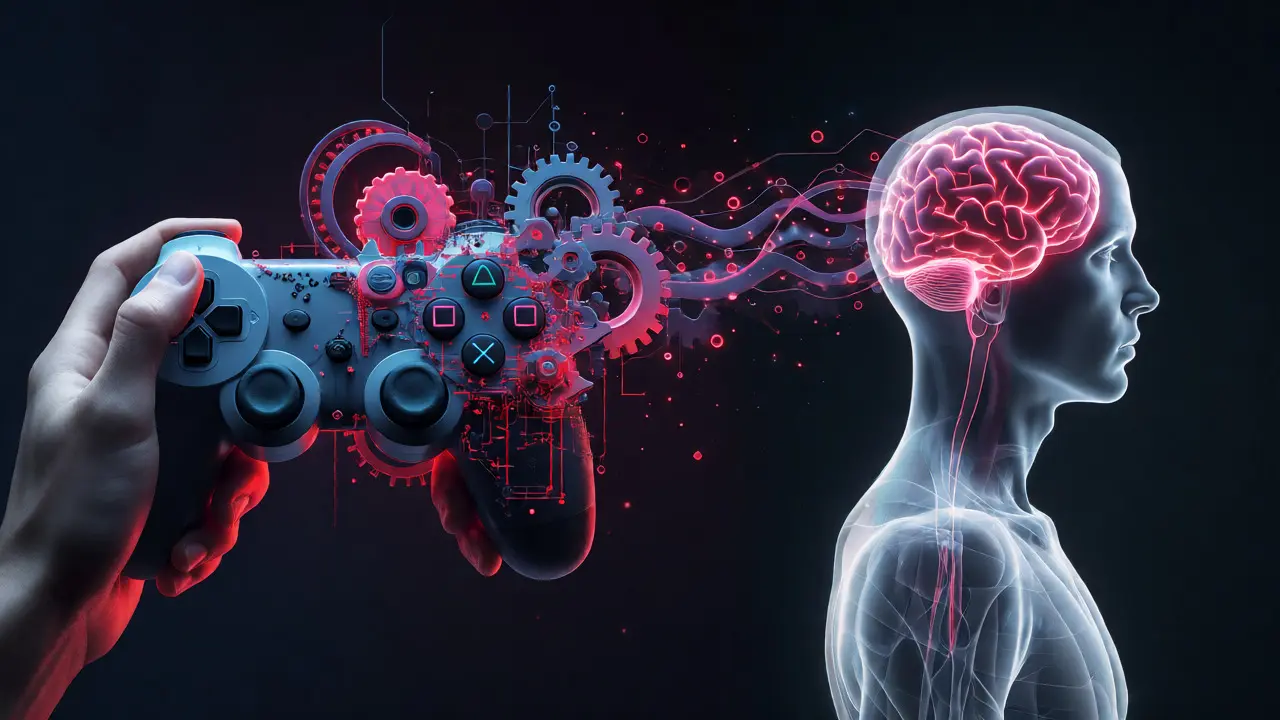
Two tiny structures deep inside your head-the nucleus accumbens and the caudate nucleus-are pulling the strings. They are part of the basal ganglia, a group of nuclei responsible for motor control, learning, and emotion. When you play video games, you aren’t just having fun; you are actively rewiring these regions. Understanding how they work helps you figure out why gaming feels so good, why it can be hard to stop, and how to keep it healthy.
The Dopamine Engine: Inside the Nucleus Accumbens
Think of the nucleus accumbens as the brain’s reward center. It doesn’t necessarily create pleasure itself; instead, it processes motivation and reinforcement. This structure is heavily populated with dopamine receptors. When you get a loot drop, level up, or win a match, your brain releases a surge of dopamine into this area.
This isn’t random noise. The nucleus accumbens is designed to help you remember what was worth doing. In evolutionary terms, finding food or social connection triggered this system. Video games hack this ancient circuitry. They provide frequent, predictable, and intense rewards that natural life rarely matches. A study published in Nature Neuroscience showed that playing violent video games caused significant increases in dopamine release in the ventral striatum (which includes the nucleus accumbens). The more unpredictable the reward (like opening a loot box), the stronger the response. This variable ratio reinforcement schedule is the same mechanism used in slot machines, and it lights up the nucleus accumbens like a Christmas tree.
Habit Formation: The Role of the Caudate Nucleus
If the nucleus accumbens is about "wanting," the caudate nucleus is about "doing." Located in the dorsal striatum, the caudate is crucial for habit formation and procedural learning. When you first start playing a complex game like Elden Ring, you are conscious of every button press. You are thinking about combos, timing, and enemy patterns. This is controlled by the prefrontal cortex, which is slow and energy-expensive.
As you play more, the activity shifts from the prefrontal cortex to the caudate nucleus. The actions become automatic. You don’t think about dodging; you just dodge. This transfer of control is efficient-it frees up mental bandwidth-but it also makes behaviors harder to break. Research using functional MRI scans has shown that heavy gamers exhibit increased gray matter volume in the caudate nucleus compared to non-gamers. Their brains have physically adapted to make gaming a default, habitual response. Once the caudate takes over, stopping the game requires active willpower because the habit loop is already running on autopilot.
How Games Rewire These Regions
Gaming doesn’t just activate these areas; it changes their structure and connectivity. This neuroplasticity works both ways. For some, it enhances cognitive skills. For others, it leads to desensitization or compulsive behavior.
| Brain Region | Primary Function | Effect of Heavy Gaming | Real-World Consequence |
|---|---|---|---|
| Nucleus Accumbens | Reward processing, motivation | Heightened sensitivity to digital cues; potential downregulation of dopamine receptors | Real-life achievements feel less rewarding; craving for next gaming session |
| Caudate Nucleus | Habit formation, procedural memory | Increased volume and activity; faster habit consolidation | Automatic reaching for controller; difficulty switching tasks |
| Prefrontal Cortex | Decision making, impulse control | Weakened connectivity to reward centers | Impulsive spending on microtransactions; poor time management |
The critical issue arises when the balance tips. If the nucleus accumbens becomes hyper-sensitive to gaming rewards, everyday activities-reading a book, walking outside, talking to friends-fail to trigger enough dopamine to compete. This is known as anhedonia, where normal pleasures lose their appeal. Meanwhile, if the caudate nucleus strengthens the gaming habit too much, the prefrontal cortex (your brake pedal) struggles to override the urge to play. You end up in a loop where the "want" (accumbens) and the "habit" (caudate) overpower the "should" (prefrontal cortex).
Loot Boxes and Microtransactions: Exploiting the Circuit
Modern game design understands this biology better than most psychologists. Loot boxes, gacha mechanics, and daily login bonuses are engineered to target the nucleus accumbens specifically. Because the reward is uncertain, the dopamine spike is higher than if the reward were guaranteed. This uncertainty keeps the brain engaged longer.
A 2019 study in Addiction Biology found that individuals who spent money on loot boxes showed brain activation patterns similar to those seen in gambling disorders. The caudate nucleus reinforces the action of clicking "open box," even if the result is disappointing. Why? Because the near-miss triggers almost as much activity as a win. Over time, players develop a tolerance. What once excited them now requires bigger payouts or more frequent interactions to achieve the same neurological effect. This is why mobile games often bombard you with notifications-they are trying to re-trigger that initial dopamine rush before your baseline resets.
Is All Gaming Bad? The Upside of Neuroplasticity
Don’t panic. Not all changes to the caudate and nucleus accumbens are negative. Enhanced connectivity between these regions can improve reaction times, spatial awareness, and decision-making under pressure. Action gamers often show superior performance in visual attention tasks. The key is moderation and intentionality.
Healthy gaming uses these circuits for skill acquisition. Unhealthy gaming uses them for avoidance. If you play to master a mechanic, your caudate nucleus is helping you learn efficiently. If you play to numb stress or escape reality, your nucleus accumbens may be driving compulsive consumption. Recognizing which mode you are in allows you to adjust your habits before structural changes become entrenched.
Taking Control: Practical Strategies for Balance
You don’t need to quit gaming forever. You just need to manage the interaction between your reward system and your habit loops. Here are actionable steps based on neurobiology:
- Introduce Friction: Since the caudate nucleus drives automatic habits, add small barriers. Unplug the console after use. Remove shortcut icons from your desktop. Make the first step to gaming require effort.
- Reset Dopamine Sensitivity: Take short breaks (48-72 hours) without gaming. This allows dopamine receptors in the nucleus accumbens to resensitize. Real-world activities will start to feel rewarding again.
- Pre-commit to Time Limits: Use external timers rather than relying on willpower. The prefrontal cortex fatigues quickly. An alarm serves as an external cue to interrupt the habit loop before it escalates.
- Mix Reward Types: Avoid games that rely solely on variable rewards (loot boxes). Choose games with clear, skill-based progression. This engages the caudate for learning rather than just triggering the accumbens for chance-based hits.
What is the main difference between the nucleus accumbens and the caudate nucleus?
The nucleus accumbens is primarily involved in reward processing and motivation (the "wanting" phase), while the caudate nucleus is involved in habit formation and procedural learning (the "doing" phase). The accumbens drives you to seek a reward, whereas the caudate automates the actions needed to get it.
Can gaming permanently damage these brain regions?
In adults, permanent structural damage is rare unless accompanied by other health issues. However, functional changes such as reduced dopamine receptor density can persist for months. With abstinence or moderated play, neuroplasticity allows these systems to recover and rebalance.
Why do I feel bored after gaming?
This is due to dopamine depletion and receptor downregulation in the nucleus accumbens. After a high-stimulation session, your baseline dopamine levels drop below normal temporarily, making ordinary activities feel unrewarding until the system recovers.
Do mobile games affect the brain differently than console games?
Mobile games often exploit the nucleus accumbens more aggressively through frequent, low-effort rewards and notifications. Console games may engage the caudate nucleus more deeply due to complex motor controls and longer session durations, leading to stronger habit formation.
How long does it take for the brain to reset after heavy gaming?
While acute dopamine recovery happens within days, structural habit changes in the caudate nucleus can take weeks or months to weaken. Consistent reduction in playtime over 30-60 days typically shows noticeable improvements in focus and mood regulation.