
Imagine sitting in a quiet room, staring at a screen that shows nothing but your favorite game’s logo. You aren’t playing. You aren’t even allowed to touch the controller. Yet, your heart rate spikes, your palms sweat, and an overwhelming urge to play takes over. This isn’t just frustration; it is a scientifically engineered state known as craving induction.
In the field of neurobiology and psychology, researchers need more than self-reports to understand gaming disorder. They need to see what happens in the brain when a person craves a digital experience they cannot have. To do this, they use specific experimental methods called craving induction protocols. These protocols are designed to trigger the intense desire for a behavior-like gaming-in a controlled laboratory setting.
The Science Behind Craving Induction
Craving is not just a feeling; it is a complex neurobiological process involving the brain's reward system. When we talk about gaming addiction, we are often discussing how the brain responds to variable rewards, social connection, and immersive feedback loops found in video games. The central entity here is the craving response, which is a physiological and psychological state characterized by an intense desire to engage in a specific behavior despite negative consequences.
To study this, scientists rely on the concept of cue reactivity. In simple terms, cues are environmental triggers that signal the availability of a reward. For a gamer, these cues might be the sound of a level-up chime, the visual of a loot box opening, or the sight of a familiar avatar. By exposing participants to these cues without allowing them to play, researchers can induce craving and measure the resulting neural activity.
This approach connects directly to the dopamine reward pathway, which is a neural circuit in the brain that processes motivation, pleasure, and reinforcement learning. When a gamer anticipates a reward, dopamine levels rise. Craving induction protocols aim to spike this anticipation artificially to observe how addicted individuals differ from non-addicted players in their neural responses.
Common Experimental Protocols
Researchers have developed several standardized ways to induce craving. Each method has its strengths and limitations, and choosing the right one depends on what aspect of addiction the study aims to explore. Here are the most common approaches used in modern labs.
- Visual Cue Exposure: Participants watch short clips of gameplay, trailers, or live streams of their preferred game. The key is that the content must be highly personalized. A clip of a generic puzzle game will not induce craving in someone addicted to competitive first-person shooters. Researchers often ask participants to select their own top three games beforehand to ensure the stimuli are potent enough.
- Imagery Scripts: In this verbal protocol, participants are guided through a mental exercise. They are asked to close their eyes and vividly imagine themselves playing their favorite game. They visualize the controls, the sounds, the graphics, and the feelings of achievement. This method relies on the participant’s ability to generate strong mental imagery, making it less reliable for those with poor visualization skills but useful for studying internal cognitive processes.
- Sensory Simulation: Some advanced setups use multi-sensory cues. This might include hearing the specific audio tracks from a game, smelling scents associated with gaming environments (like the smell of electronics or energy drinks), or even holding a controller that vibrates with familiar patterns. This creates a more immersive 'fake' experience that can trigger stronger physiological responses.
- Abstinence Paradigms: This involves asking participants to refrain from gaming for a set period (e.g., 24 hours) before the experiment. The longer the abstinence, the higher the baseline craving. While effective, this method introduces confounding variables, such as withdrawal symptoms or general irritability, which can skew results.
Measuring the Response
Inducing the craving is only half the battle. The real value lies in measuring how the body and brain react. Researchers use a combination of subjective and objective measures to get a complete picture.
| Measurement Type | Specific Tools/Metrics | What It Reveals |
|---|---|---|
| Subjective Self-Report | Visual Analog Scales (VAS), Penn Craving Scale | The conscious intensity of the urge to play |
| Physiological | Heart Rate Variability (HRV), Skin Conductance (GSR) | Autonomic nervous system arousal and stress levels |
| Neuroimaging | fMRI, EEG | Activity in the striatum, prefrontal cortex, and amygdala |
| Behavioral | Reaction time tasks, Go/No-Go tasks | Impulse control and attentional bias toward gaming cues |
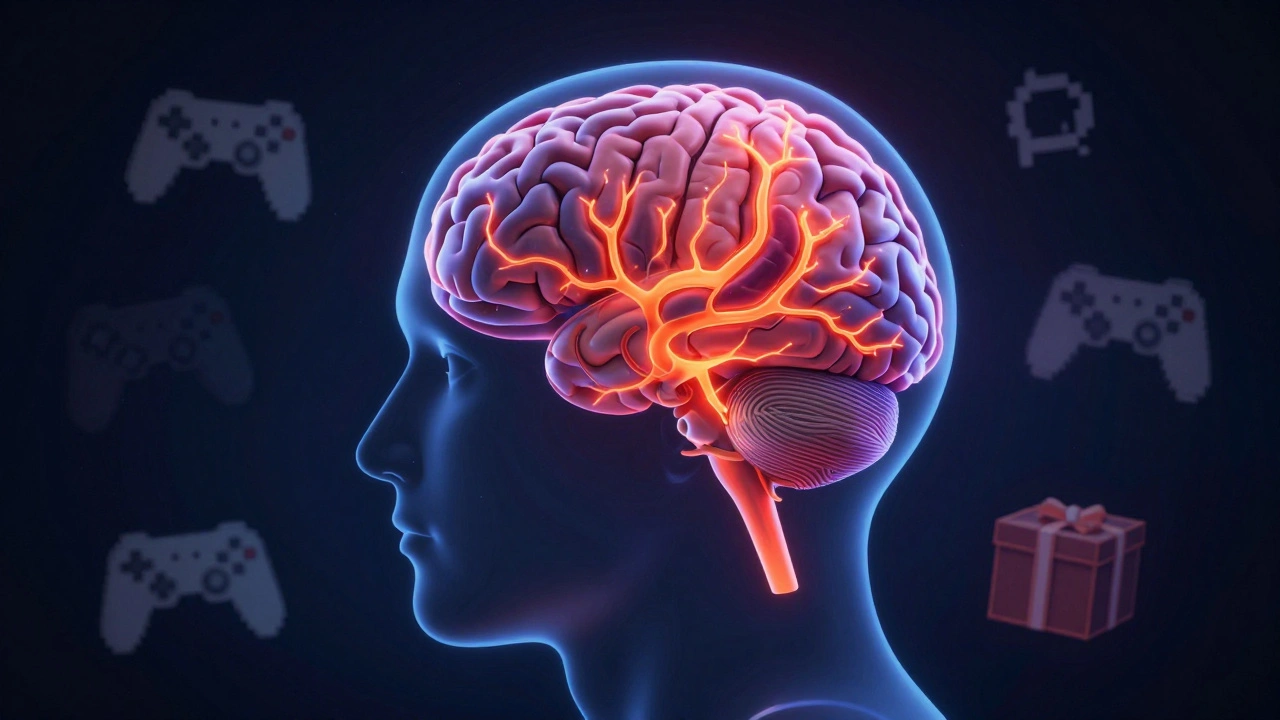
For instance, functional magnetic resonance imaging (fMRI is a medical imaging technique that uses magnetic fields and radio waves to produce images of the organs in the body) allows researchers to see exactly which parts of the brain light up during craving. Studies consistently show that addicted gamers have heightened activity in the nucleus accumbens (the reward center) when exposed to gaming cues compared to healthy controls. Meanwhile, the prefrontal cortex, responsible for decision-making and impulse control, often shows reduced activity, explaining why resisting the urge feels so difficult.
Ethical Considerations in Lab Settings
Deliberately making people crave something they struggle to control raises significant ethical questions. Researchers must balance scientific rigor with participant welfare. The primary concern is psychological distress, which refers to emotional suffering that may be experienced by anyone dealing with various life challenges.
Protocols must include strict safety guidelines. If a participant’s anxiety or craving levels exceed a predetermined threshold, the session must be terminated immediately. Participants are usually provided with a 'cool-down' period after the experiment, where they can engage in neutral activities or, in some cases, are allowed to play briefly to alleviate the induced craving. Informed consent is critical; participants must fully understand that they will be exposed to triggers and that they may feel uncomfortable urges.
Additionally, there is the risk of relapse. For individuals who have recently quit gaming, intense craving induction could potentially trigger a return to addictive behaviors. Therefore, screening tools like the Internet Gaming Disorder Scale (IGDS) are used to assess severity before enrollment. Mild cases might be suitable for lab studies, while severe cases requiring clinical intervention should be referred to treatment rather than research.
From Lab to Treatment
Why go through all this trouble? The ultimate goal of craving induction research is not just to satisfy academic curiosity but to improve treatments. By understanding the neural mechanisms of craving, clinicians can develop better therapies.
One promising application is cue exposure therapy, which is a behavioral treatment that involves repeated exposure to substance-related cues without reinforcement. Originally used for alcohol and drug addiction, this therapy is now being adapted for gaming disorder. The idea is to help patients learn that the cue (the game icon) does not necessarily lead to the reward (playing), thereby weakening the association over time. Craving induction protocols provide the controlled environment needed to practice this resistance safely.
Furthermore, neurofeedback techniques are emerging. By monitoring brain activity in real-time, patients can learn to regulate their own neural responses to gaming cues. If a patient sees their craving-related brain activity decrease on a screen, they can reinforce the mental strategies that led to that reduction. This turns abstract self-control into a tangible, measurable skill.

Challenges and Future Directions
Despite progress, the field faces hurdles. One major issue is the diversity of gaming experiences. Unlike alcohol or nicotine, which are uniform substances, games vary wildly in mechanics, social features, and emotional engagement. A craving induction protocol for a solitary puzzle game looks very different from one for a massive multiplayer online role-playing game (MMORPG). This makes standardization difficult across studies.
Another challenge is the rapid evolution of technology. Virtual reality (VR) and augmented reality (AR) offer new avenues for immersion. Future protocols may involve VR environments that simulate gaming contexts with unprecedented realism. However, this also raises new ethical concerns about the intensity of the induced states. As the simulations become more lifelike, the line between experimental induction and actual gaming blurs, requiring stricter oversight.
Researchers are also looking into genetic factors. Preliminary studies suggest that certain genetic variants related to dopamine receptor density may make some individuals more susceptible to craving. Integrating genetic data with neuroimaging results could lead to personalized medicine approaches, where treatments are tailored to an individual’s biological profile rather than a one-size-fits-all model.
Conclusion
Craving induction protocols are powerful tools that allow us to peek inside the black box of gaming addiction. By triggering and measuring these intense urges, we gain insights into the neurobiological roots of compulsive behavior. While ethically complex and methodologically challenging, these studies are paving the way for more effective, science-based interventions. As our understanding deepens, so too does our ability to help those trapped in the cycle of digital compulsion find their way back to balance.
What is a craving induction protocol?
A craving induction protocol is a structured experimental procedure used in research to deliberately trigger an intense desire for a specific behavior, such as gaming, in a controlled setting. This allows researchers to study the physiological and neurological responses associated with addiction.
How do researchers measure craving in the lab?
Researchers use a combination of methods including self-report scales (where participants rate their urge intensity), physiological monitors (tracking heart rate and skin conductance), and neuroimaging techniques like fMRI to observe brain activity in real-time.
Is it ethical to induce cravings in participants?
Yes, if conducted under strict ethical guidelines. Participants must give informed consent, undergo thorough screening, and have the option to withdraw at any time. Safety protocols are in place to monitor distress levels, and sessions are stopped if discomfort becomes too high.
Why is personalization important in these protocols?
Personalization ensures that the cues used (such as game clips or imagery) are relevant and potent enough to trigger a genuine craving response. Generic stimuli may not elicit strong reactions in addicted individuals, leading to inaccurate data.
How does this research help treat gaming addiction?
By understanding the neural mechanisms of craving, clinicians can develop targeted therapies like cue exposure therapy and neurofeedback. These treatments help patients learn to manage their impulses and weaken the brain's automatic response to gaming cues.