You know that feeling. You’re walking past a store, or maybe just scrolling through your phone, and you see a box for the new Call of Duty release. Your heart rate ticks up. Your palms get slightly sweaty. You don’t even think about buying it yet; your brain has already decided it wants the hit. That immediate, visceral pull is what scientists call cue reactivity. It’s not just "wanting" something-it’s a hardwired neurological reflex where external triggers hijack your reward system before your conscious mind can intervene.
If you’ve ever wondered why you can’t stop checking loot boxes or why the sound of a slot machine in a casino makes you twitch, this article breaks down exactly what’s happening inside your skull. We aren’t talking about vague psychology here. We are looking at concrete fMRI data showing how specific visual and auditory cues light up the ventral striatum in heavy gamers, often more intensely than actual rewards do.
The Neuroscience of the Trigger
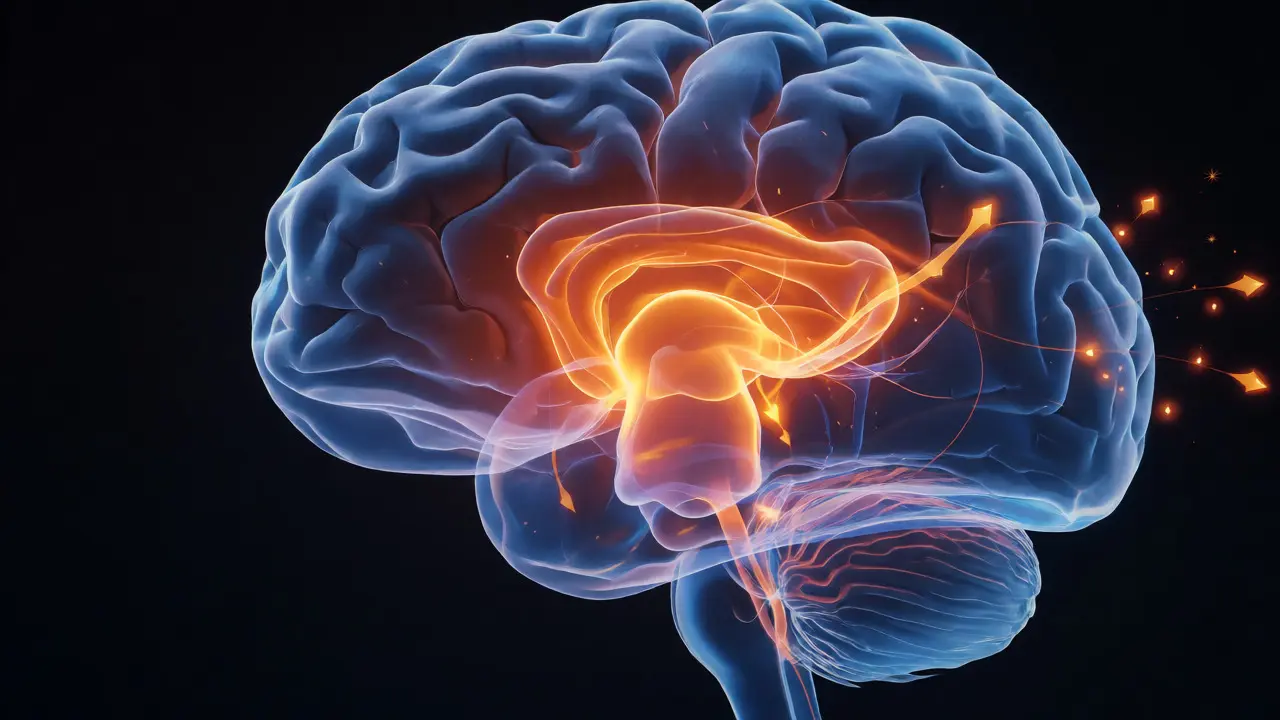
To understand cue reactivity, you have to look at the mesolimbic pathway, often called the brain's reward circuit. This system relies heavily on dopamine, a neurotransmitter responsible for motivation and anticipation. In a non-gamer, seeing a picture of food might trigger a small dopamine release if they are hungry. But in chronic gamers, functional magnetic resonance imaging (fMRI) studies show a different pattern. When shown images of game controllers, loading screens, or specific game characters, their brains spike with activity in the nucleus accumbens-the pleasure center-even when they aren’t playing.
This isn't just excitement. It’s a conditioned response, similar to Pavlov’s dog salivating at the bell. The game mechanics (the bell) have become so tightly linked with the dopamine hit (the food) that the mere sight of the interface triggers the chemical flood. Researchers at Stanford University found that in individuals with high gaming usage, the amygdala (emotional processing) and the prefrontal cortex (decision making) showed reduced connectivity when exposed to these cues. Basically, the emotional pull overrides the logical brake pedal.
What fMRI Studies Actually Show
Let’s get specific about the data. A landmark study published in Addiction Biology compared two groups: healthy controls and individuals diagnosed with Internet Gaming Disorder (IGD). Participants were scanned while viewing three types of stimuli: neutral images (trees, chairs), real-life rewarding images (money, friends), and game-related cues (game logos, character art).
- Neutral Cues: Both groups showed minimal activation in reward areas.
- Real-Life Rewards: Healthy controls showed strong activation in the ventral striatum. IGD participants showed significantly weaker responses.
- Game Cues: Here’s the twist. IGD participants showed hyper-activation in the dorsal striatum and insula, regions associated with habit formation and craving intensity. Their brains reacted to a static image of a game logo as if they were actually winning a jackpot.
This dissociation is critical. The brain stops responding normally to everyday joys (socializing, eating, achieving goals) because those stimuli don’t provide the rapid-fire, variable-ratio reinforcement that video games do. Instead, the neural hardware rewires itself to prioritize digital cues above all else.
Visual vs. Auditory Cues: Which Hits Harder?
Not all cues are created equal. Game designers spend millions optimizing sensory inputs, and neuroscience backs up their instincts. fMRI meta-analyses suggest that auditory cues often bypass higher-level cognitive filtering faster than visual ones. Think about the distinct "ding" of a level-up or the specific jingle of a mobile game ad. These sounds activate the auditory cortex and immediately project signals to the limbic system.
Visual cues, particularly bright colors and motion, engage the visual cortex but require slightly more processing time to trigger the same dopaminergic surge. However, when combined-like the flashy animation accompanying a loot box opening-the effect is synergistic. The anterior cingulate cortex, which monitors conflict and error, lights up intensely during these moments, signaling that something important is happening and demanding attention.
| Cue Type | Primary Brain Region Activated | Dopamine Spike Level | Conscious Awareness |
|---|---|---|---|
| Auditory (e.g., notification chime) | Auditory Cortex → Amygdala | High / Immediate | Low (Reflexive) |
| Visual Static (e.g., Logo) | Visual Cortex → Nucleus Accumbens | Moderate | Moderate |
| Interactive (e.g., Button Press) | Motor Cortex → Ventral Striatum | Very High | High (Action-Oriented) |
The Role of Variable Ratio Reinforcement
Why do some games hook us harder than others? It comes down to unpredictability. If every button press gave you a cookie, you’d eventually get bored. But if you only got a cookie sometimes-and never knew when-the anticipation became addictive. This is known as variable ratio reinforcement, the same mechanism used in slot machines.
fMRI scans reveal that uncertainty amplifies cue reactivity. When a gamer sees a closed loot box, the brain doesn’t know if the reward will be common or legendary. This uncertainty causes a larger dopamine release upon opening than if the reward had been guaranteed. The cue (the closed box) becomes more potent than the reward itself because the potential for a high-value outcome keeps the system on high alert. Over time, the brain learns to crave the *possibility* rather than the object, leading to compulsive clicking even when the actual prizes are worthless.

Implications for Daily Life and Mental Health
So, what does this mean for you? If your brain is wired to react strongly to digital cues, your environment matters. Seeing a controller on the desk isn’t neutral; it’s a trigger. Research indicates that cue exposure increases cortisol levels and subjective cravings within minutes. For someone trying to cut back on gaming, relying on willpower alone is like trying to hold back a tsunami with a spoon. The biological drive is too strong.
Furthermore, this reactivity spills over into other areas. Individuals with high cue reactivity often report difficulty focusing on tasks with delayed gratification, such as studying or long-term projects. Why read a textbook chapter for a grade next month when you can get an immediate dopamine hit from clearing a stage right now? The brain prioritizes the immediate, high-intensity signal over the slow, low-intensity one.
Strategies to Rewire the Response
You can’t delete the neural pathways, but you can weaken them. Neuroplasticity works both ways. Here is a practical approach based on behavioral neuroscience principles:
- Identify Your Triggers: Keep a log for three days. Note every time you feel the urge to play. Was it boredom? Stress? Or did you just hear a specific sound? Recognizing the cue is the first step to disarming it.
- Friction Design: Increase the effort required to start playing. Unplug the console. Log out of accounts. Move apps off the home screen. Every second of delay allows the prefrontal cortex to catch up with the limbic system.
- Cue Exposure Therapy: Paradoxically, avoiding cues entirely can make them more powerful. Try controlled exposure. Look at the game icon for ten seconds without playing. Notice the craving rise, then fall. This teaches your brain that the cue does not always lead to the reward, weakening the association.
- Replace the Reward: Find offline activities that offer similar sensory feedback. Exercise releases endorphins; creative hobbies provide flow states. The goal isn’t to eliminate fun, but to diversify your sources of dopamine.
Is cue reactivity permanent?
No, it is not permanent. While the neural pathways are established, neuroplasticity allows them to fade with disuse. Studies show that after 4-8 weeks of abstinence or moderated use, fMRI scans indicate a reduction in hyper-activation toward game cues, returning closer to baseline levels seen in non-gamers.
Do casual gamers experience cue reactivity?
Yes, but typically to a lesser degree. Casual players may still feel a pull when seeing popular titles, but their brain scans usually show normal connectivity between the prefrontal cortex and reward centers. They retain the ability to inhibit the impulse easily, whereas heavy users struggle with this regulatory control.
How does mobile gaming differ from console gaming in terms of cues?
Mobile gaming relies more heavily on micro-cues, such as push notifications and haptic feedback (vibrations), which are designed to interrupt daily life constantly. Console gaming cues are often tied to specific environments (the TV, the controller). Mobile cues are ubiquitous, making them harder to avoid and potentially leading to higher frequency, lower-intensity cravings throughout the day.
Can medication help reduce cue reactivity?
Some medications used for addiction, such as naltrexone, aim to block opioid receptors involved in the reward pathway, potentially blunting the dopamine response. However, these are not standard treatments for general gaming habits and should only be considered under medical supervision for severe cases resembling substance use disorders.
Does watching streamers trigger cue reactivity?
Absolutely. Watching gameplay activates mirror neurons and vicarious reward systems. Seeing a streamer open a rare item can trigger a sympathetic dopamine response in the viewer. For many, watching streams serves as a substitute for playing, keeping the cue-reward loop active even without direct interaction.