
Imagine you are playing a mobile game. You run out of lives, so you open the store to buy more. The button for $99.99 is bright green and pulsing. The button for $0.99 is tiny, gray, and almost invisible. You click the big green button by mistake-or maybe not by mistake-and suddenly you have spent your weekly grocery budget on virtual gems. This isn’t an accident. It is design.
We call these manipulative interface tricks dark patterns. They are user interface designs created specifically to trick users into doing things they didn't mean to do, like buying expensive items or subscribing to services they don't want. In the world of in-game stores, dark patterns are the engine behind billions of dollars in revenue. But they also erode trust, frustrate players, and blur the line between entertainment and exploitation.
The Psychology Behind the Purchase
To understand why dark patterns work, we have to look at how our brains make decisions. Most purchases in games are impulsive. Developers know this. They use principles from behavioral psychology to bypass your logical brain and trigger your emotional one.
One common tactic is scarcity. You see a timer counting down: "Offer expires in 5 minutes!" Your brain perceives a threat of loss. Losing a deal feels worse than gaining the same value. This triggers a fear of missing out (FOMO). Even if you didn't want the item ten seconds ago, now you feel you must have it before the clock hits zero.
Another powerful tool is social proof. A pop-up appears saying, "1,243 players bought this bundle today." You think, "If everyone else is buying it, it must be good." In reality, that number might be fabricated, or it might include people who bought it years ago. The goal isn't accuracy; it's pressure.
Then there is anchoring. The store shows a $100 pack next to a $10 pack. The $100 pack looks like a steal because it offers "10x value." Your brain anchors on the high price, making the mid-tier options seem reasonable by comparison. You end up spending more than you planned because the reference point was skewed.
Common Dark Patterns in Game Stores
Not all manipulation is subtle. Some dark patterns are aggressive and obvious once you know what to look for. Here are the most frequent tactics used in modern mobile and PC games.
- Bait and Switch: You click "Buy Coins," but the default selection is already set to the most expensive package. To buy the cheap version, you have to scroll through three screens of upsells.
- Confirmshaming: When you try to close a popup offering a discount, the button says, "No, I hate saving money." Guilt is a strong motivator. Designers use shame to keep you engaged with the offer.
- Hidden Costs: The price shown is low, but taxes, fees, or required subscriptions are added at the very last step of the checkout process. By then, you've already committed mentally to the purchase.
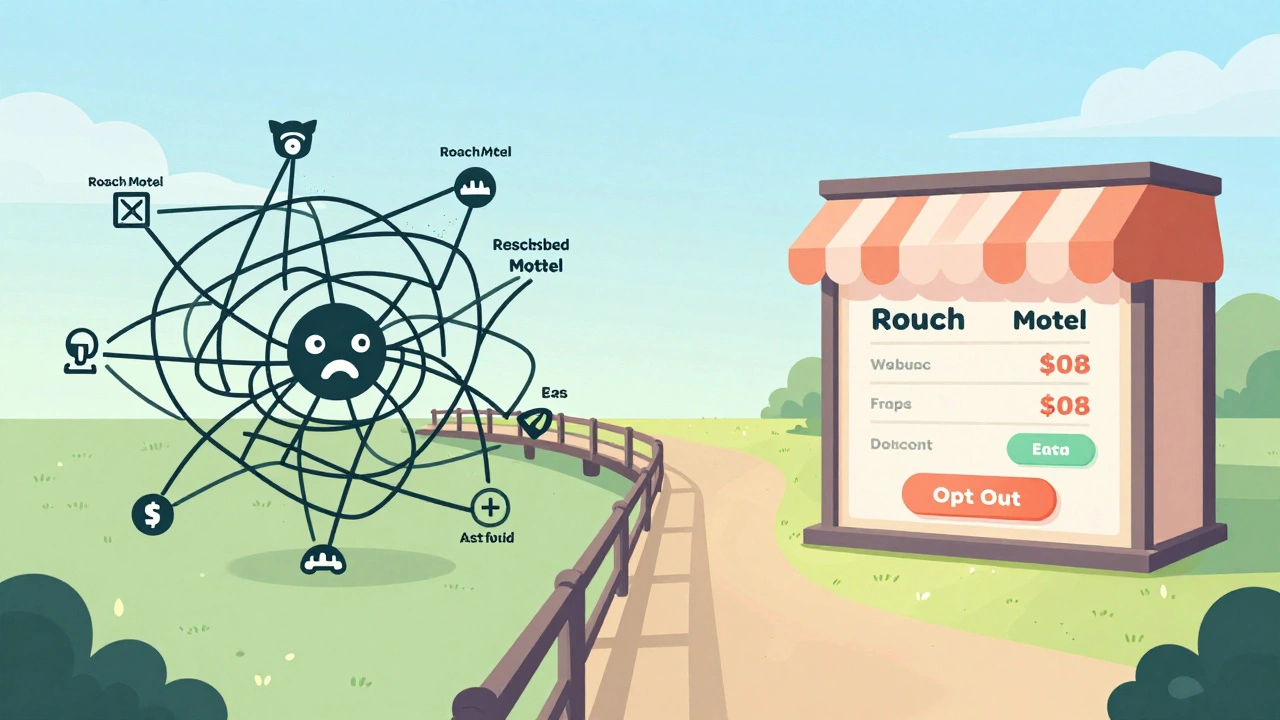
- Roach Motel: You can easily sign up for a free trial or subscribe to a battle pass, but canceling requires navigating a labyrinth of menus, phone calls, or hidden settings. Getting in is easy; getting out is hard.
- Forced Action: The game disables core features unless you watch ads or buy currency. Progression is artificially slowed to create frustration, which the store then promises to cure.
These patterns exploit cognitive biases. They work because they target moments of high emotion-frustration after losing a match, excitement after winning, or boredom during downtime.

The Business Case: Revenue vs. Trust
Why do companies use dark patterns? Because they generate immediate revenue. In the freemium model, where the base game is free, monetization relies on a small percentage of players spending large amounts. These players are often called "whales."
Dark patterns help identify and extract value from whales. They also convert casual players into spenders by lowering the barrier to impulse buys. A study by the University of Cambridge found that nearly 60% of children aged 7-12 had made unintended in-app purchases due to confusing interfaces.
However, this strategy has long-term risks. Players are not stupid; they are just tired. Over time, repeated manipulation leads to distrust. Players uninstall games, leave negative reviews, and share their experiences on social media. Brand damage is real. Companies that rely too heavily on dark patterns often see declining retention rates after the first few months.
Sustainable monetization requires balance. Games that respect player agency tend to build loyal communities. Players who feel respected are more likely to spend voluntarily over time, rather than being forced into transactions they resent.
Regulatory Pushback and Legal Risks
The era of unchecked dark patterns is ending. Governments worldwide are waking up to the problem. In the European Union, the Digital Services Act and consumer protection laws explicitly ban certain manipulative practices. The UK's Competition and Markets Authority has investigated several major tech companies for misleading interfaces.
In the United States, the Federal Trade Commission (FTC) has issued warnings about deceptive design in apps and games. While enforcement is still evolving, the trend is clear: regulators are treating dark patterns as unfair business practices.
Companies face financial penalties, forced redesigns, and reputational harm. For example, a popular mobile game was fined millions after investigations revealed that its "free" trial auto-renewed without clear consent. The company had to refund thousands of users and redesign its entire payment flow.
Legal compliance is no longer optional. It is a core part of product development. Design teams must now consider legal ethics alongside user experience.
Ethical Alternatives: Designing with Respect
You don't need dark patterns to make money. Ethical design can drive sustainable revenue while building trust. Here are some alternatives.
- Transparent Pricing: Show all costs upfront. No hidden fees, no surprise renewals. Let players know exactly what they are paying for.
- Clear Opt-Outs: Make cancellation as easy as subscription. If a player wants to stop paying, let them do it in two clicks.
- Value-Based Offers: Offer discounts based on actual value, not artificial scarcity. Loyalty rewards should reflect real engagement, not manipulation.
- Player Choice: Allow players to customize their experience. Let them choose how much they want to spend, without pressure or guilt.
- Education: Help players understand the economy of the game. Explain what items do and how they affect gameplay. Informed decisions lead to happier customers.
Games that adopt these principles often see higher lifetime value per user. Players return because they feel respected, not exploited. Trust is a currency, and it appreciates over time.
How to Spot and Avoid Dark Patterns
As a player, you can protect yourself. Awareness is the first step. Here is what to look for.
- Check the Default Selection: Before clicking "Buy," verify that you are selecting the package you intended. Don't assume the highlighted option is the cheapest.
- Ignore Urgency: If a timer says "Expires in 5 minutes," wait. Real deals don't disappear instantly. Scarcity is often fake.
- Read the Fine Print: Look for auto-renewal clauses, subscription terms, and hidden fees. If it's buried in small text, it's probably important.
- Use Parental Controls: For younger players, enable restrictions on in-app purchases. Require a password for every transaction.
- Uninstall and Reconsider: If a game constantly pressures you to spend, ask yourself if it's worth the stress. There are plenty of games that respect your time and wallet.
Remember, you are not obligated to buy anything. The game should be fun even if you never spend a cent. If it isn't, the design is flawed.
What are dark patterns in gaming?
Dark patterns are deceptive user interface designs that trick players into making unwanted purchases or actions. Examples include fake urgency, hidden costs, and difficult cancellation processes.
Are dark patterns illegal?
In many regions, yes. Laws in the EU, UK, and US increasingly classify certain dark patterns as unfair or deceptive trade practices. Companies can face fines and forced redesigns.
How do dark patterns affect player trust?
They erode trust significantly. Players who feel manipulated are less likely to return, more likely to leave negative reviews, and may avoid the developer's future titles.
Can ethical design still be profitable?
Yes. Ethical design builds long-term loyalty. Players who feel respected tend to spend more consistently over time, leading to higher lifetime value compared to short-term gains from manipulation.
How can parents protect kids from dark patterns?
Enable parental controls on devices, require passwords for in-app purchases, and educate children about recognizing pressure tactics like fake timers or urgent pop-ups.