
Imagine the smell of fresh bread hitting your nose. Your mouth waters before you even think about eating. Now imagine that same physical pull, but triggered by the sound of a level-up or the glow of a notification badge. For millions of players, this isn't just excitement; it is a biological imperative. Recent neuroimaging studies reveal that gaming cues trigger brain activity patterns strikingly similar to those seen in substance dependence. This isn't about labeling gamers as "addicts" in a moral sense. It is about understanding the precise neural machinery that makes stopping so hard.
The Dopamine Loop: Why the Brain Hates Uncertainty
To understand why a video game can feel like a drug, we have to look at Dopamine is a neurotransmitter that signals reward prediction error and motivation, not just pleasure. In traditional drug use, dopamine spikes are massive and sustained. In gaming, the spike is smaller but highly specific. The key here is the variable ratio reinforcement schedule. Just like a slot machine, games do not reward you every time you press a button. Sometimes you win big; sometimes you get nothing. This unpredictability keeps the dopamine system on high alert.
When you see a loot box opening or a rare item drop, your brain releases dopamine in anticipation of the reward. If the reward is good, the circuit strengthens. If it's bad, the disappointment creates a negative signal that drives you to try again immediately. This cycle is what neuroscientists call the "wanting" system. It separates desire from satisfaction. You might be tired, bored, or full, but the cue still triggers the wanting response. This is why a player might say, "I'll just play one more match," only to lose track of three hours later.
Cue-Induced Craving: The Neural Fingerprint
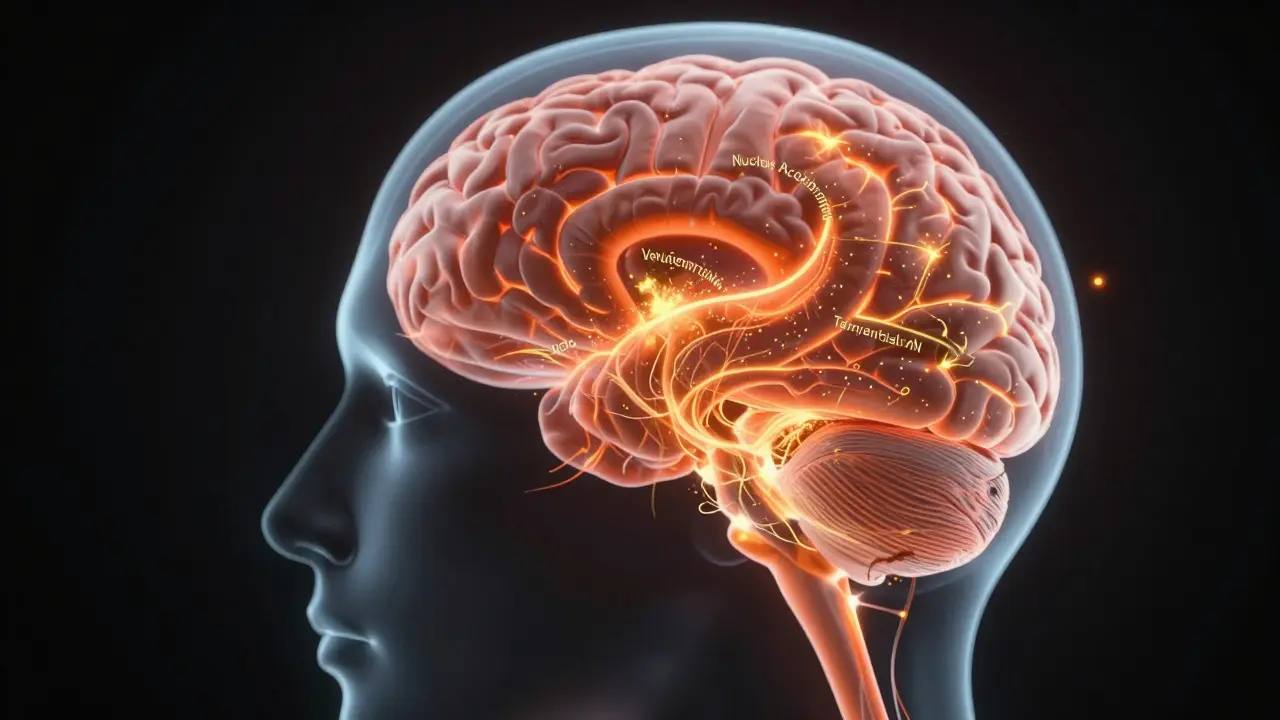
Researchers at institutions like the University of Bonn have used functional magnetic resonance imaging (fMRI) to map these reactions. They showed images of gaming gear, logos, or gameplay clips to participants with high gaming engagement scores. The results were clear. The Nucleus Accumbens is a region of the basal ganglia involved in processing rewards and reinforcing behaviors. This area lit up significantly when exposed to gaming cues. Even more telling, the Ventral Tegmental Area is the primary source of dopamine neurons projecting to the nucleus accumbens. was activated, mirroring the exact pathway used by cocaine and nicotine users when shown their respective drugs.
This is not just a correlation. It is a mechanistic overlap. When a smoker sees a cigarette pack, their VTA fires. When a gamer sees a controller or hears a specific soundtrack, their VTA fires. The intensity of this firing correlates with self-reported craving levels. If you struggle to stop playing despite negative consequences, your brain is likely responding to environmental triggers with the same force as someone responding to a chemical substance. The cue becomes the command to act, bypassing rational decision-making centers in the prefrontal cortex.
Tolerance and Withdrawal: The Physical Reality
If the brain activation is similar, what happens when you stop? Many casual observers dismiss gaming withdrawal as "just boredom." But for those with high engagement, the symptoms are physiological. A study published in the journal Addiction Biology found that individuals with problematic gaming habits experienced significant mood disturbances when prevented from playing for several days. These included irritability, anxiety, and depressed mood. These are classic signs of dopaminergic downregulation.
Your brain adapts to constant stimulation. To maintain normal mood levels, you need higher doses of the stimulus. This is tolerance. A game that used to provide hours of satisfaction now requires new updates, harder modes, or longer sessions to produce the same effect. When access is removed, the baseline dopamine levels drop below normal, creating a state of dysphoria. This isn't psychological weakness; it is homeostatic rebalancing. The body is demanding its usual input. Recognizing this helps shift the perspective from "lack of willpower" to "biological adaptation."
| Feature | Substance Dependence | Problematic Gaming |
|---|---|---|
| Primary Trigger | Chemical ingestion | Visual/Auditory cues |
| Key Brain Region | Nucleus Accumbens / VTA | Nucleus Accumbens / VTA |
| Reward Mechanism | Direct receptor binding | Variable ratio reinforcement |
| Withdrawal Symptoms | Physical + Psychological | Primarily Psychological (Mood/Irritability) |
| Tolerance Development | Requires higher dose | Requires more intense/longer play |
The Role of Prefrontal Cortex Impairment
Why doesn't the brain simply say "stop"? The answer lies in the Prefrontal Cortex is the frontal lobe region responsible for executive functions, including impulse control and long-term planning.. In healthy individuals, this area balances the reward signals from the limbic system. However, chronic overstimulation weakens the connection between the prefrontal cortex and the striatum. fMRI scans of individuals with gaming disorder show reduced gray matter volume in the left prefrontal cortex. This structural change impairs inhibitory control. Essentially, the "brakes" in the brain become less effective while the "gas pedal" (reward system) remains sensitive.
This explains the paradox of knowing you should stop but feeling unable to do so. It is not a failure of character. It is a measurable reduction in top-down regulatory capacity. As the gap widens, decisions become more automatic and less deliberative. The cue triggers the action before conscious thought can intervene. Understanding this impairment is crucial for treatment approaches, which must focus on rebuilding executive function rather than just removing the stimulus.
Identifying Problematic Patterns vs. Healthy Play
Not everyone who plays games has a neurological issue. The distinction lies in the impact on daily life and the presence of compulsive behavior. Healthy play involves voluntary choice, manageable duration, and the ability to stop without significant distress. Problematic play, aligned with the World Health Organization's definition of Gaming Disorder, involves impaired control over gaming, increasing priority given to gaming over other activities, and continuation despite negative consequences.
You can assess your own risk by asking a few simple questions:
- Do you feel restless or irritable when trying to cut down?
- Have you lost sleep or work performance due to gaming?
- Does seeing gaming ads or hearing related sounds create an immediate urge to play?
- Do you use gaming primarily to escape negative emotions rather than for enjoyment?

Breaking the Cycle: Practical Strategies
Since the problem is rooted in cue reactivity and dopamine regulation, the solution involves managing both. First, reduce exposure to non-essential cues. This means hiding controllers, muting notifications, and avoiding streaming channels when you are trying to take a break. Every uncontrolled exposure reinforces the neural pathway. Second, engage in alternative dopamine sources. Exercise, social interaction, and creative hobbies stimulate the same reward circuits but with healthier long-term profiles. Running a 5K run produces endorphins and moderate dopamine release that stabilizes mood without the crash associated with hyper-stimulation. Third, build friction. Make starting the game harder. Unplug the console after each session. Use app blockers on mobile devices. The goal is to allow the prefrontal cortex enough time to re-engage before the action begins. This pause is where recovery starts. By interrupting the automatic cue-action loop, you give your executive function a chance to override the craving.
Frequently Asked Questions
Is gaming addiction officially recognized by medical professionals?
Yes. The World Health Organization included Gaming Disorder in the ICD-11 in 2018. It is defined as a pattern of persistent or recurrent dysregulated behavior characterized by impaired control over gaming, increasing priority given to gaming, and continuation despite negative consequences. While debate exists regarding prevalence rates, the clinical criteria are established.
Do all gamers have the same brain activation patterns?
No. Research shows that only those with high levels of engagement or problematic traits exhibit the strong cue-induced craving responses. Casual players may enjoy the reward sensation without developing the same degree of neural sensitivity or prefrontal cortex impairment. The key differentiator is the compulsive nature of the response to cues.
Can video games cause permanent brain damage?
Current evidence suggests neuroplastic changes rather than permanent "damage" in the traditional sense. Gray matter density reductions in the prefrontal cortex have been observed, but these are often reversible with behavioral modification and abstinence from excessive play. The brain retains its ability to rewire itself, though recovery takes time and consistent effort.
How is gaming craving different from food cravings?
While both involve dopamine, food cravings are usually tied to metabolic needs and satiety signals. Gaming cravings are purely hedonic and driven by external cues without a biological necessity. You don't need a video game to survive, yet the brain treats the absence of the game as a deficit, leading to stronger emotional distress when denied compared to skipping a meal.
What is the best first step to reducing gaming time?
The most effective initial step is environmental design. Remove easy access to gaming devices during designated off-hours. This reduces the frequency of cue exposure. Combine this with a scheduled replacement activity, such as a walk or reading, to fill the void and prevent the vacuum that leads to relapse. Gradual reduction works better than cold turkey for many people.