
Why Your Willpower Isn't Enough
You’ve cut back. You’ve deleted the games. You’ve even thrown away the console. But then, one stressful Tuesday night, you find yourself logging back in. The shame sets in fast, followed by the familiar urge to play just "one more hour." If this sounds like your reality, you aren’t failing because you’re weak. You’re failing because you don’t have a relapse prevention plan. In a structured strategy that identifies triggers and provides actionable steps to stop compulsive behavior before it starts, willpower is replaced with systems.
Gaming disorder, as classified by the World Health Organization (WHO) in ICD-11, isn’t just about playing too much. It’s a pattern of behavior where gaming takes precedence over other life interests and daily activities. Recovery isn’t linear. Slips happen. The difference between a temporary slip and a full-blown relapse is whether you had a map to navigate the crisis when it hit.
Identifying Your Unique Triggers
The first step in any effective plan is knowing exactly what pulls you back into the loop. Triggers are rarely just "boredom." They are specific emotional states or environmental cues that signal your brain to seek the dopamine hit from gaming. To build a solid foundation, you need to track your urges for at least two weeks. Write down the time, location, and emotion preceding every urge to play.
- Emotional Triggers: Stress from work, loneliness, anxiety, or anger. Many people use gaming as a coping mechanism for negative emotions. This is often called "escapism."
- Situational Triggers: Being alone in your bedroom, having an empty evening schedule, or seeing friends post about new game releases on social media.
- Physiological Triggers: Fatigue, hunger, or lack of sleep. When your prefrontal cortex is tired, your impulse control drops significantly.
For example, if you notice you always want to play after a difficult meeting at work, the trigger isn’t "gaming"-it’s "work stress." Your plan needs to address the stress, not just block the game.
Building Your Actionable Response Plan
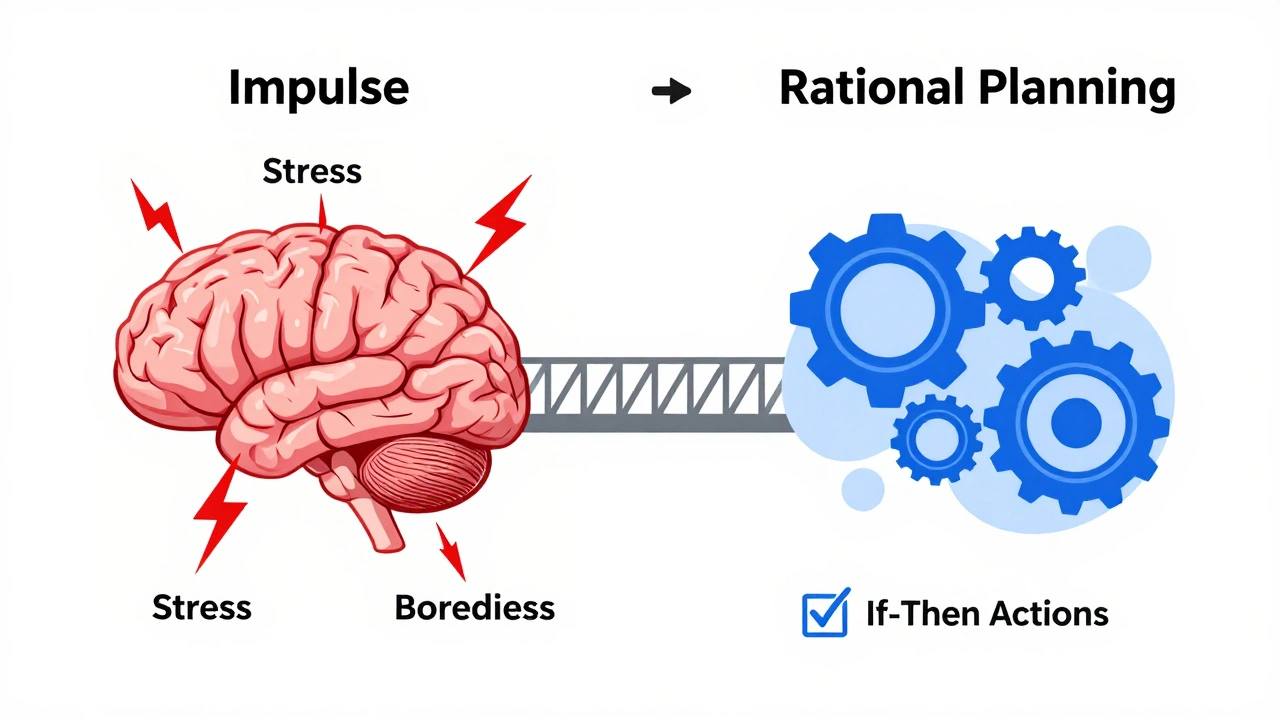
Once you know your triggers, you need pre-planned responses. This is the core of your relapse prevention plan. It consists of immediate, concrete actions to take when an urge arises, designed to break the automatic habit loop. Vague promises like "I’ll try harder" don’t work. Specific actions do.
Create an "If-Then" chain for each major trigger. This technique, known as implementation intentions, has been shown in psychological studies to increase success rates in behavior change.
| Trigger Scenario | If (The Cue) | Then (The Action) |
|---|---|---|
| After work stress | I feel overwhelmed and reach for my mouse | I immediately stand up, drink a glass of water, and walk outside for 5 minutes. |
| Boredom at home | I sit on the couch with nothing to do | I open my bookshelf and pick a physical book, or call a friend. |
| Social pressure | A friend invites me to raid | I reply: "I’m taking a break right now, but let’s grab coffee instead." |
Environmental Design: Making Gaming Harder
Relying on self-control is a losing battle against billion-dollar engagement algorithms. You must redesign your environment to make gaming inconvenient and non-gaming activities easier. This concept is central to behavioral modification.
Start with physical barriers. If you play on a PC, remove the keyboard from your desk and store it in another room. If you use a console, unplug it and put it in a closet. Add friction. Every extra step you force yourself to take gives your rational brain time to catch up with your impulsive brain.
Use software tools to enforce these boundaries. Applications like Cold Turkey Blocker or Freedom can block access to gaming platforms during set hours. Set these blocks during your most vulnerable times, such as late at night or early mornings. Don’t give yourself the option to override them. Have a trusted friend hold the password if necessary.
The Role of Social Accountability
Isolation fuels addiction. Gaming is often a solitary activity, even when played online. Recovery requires reconnection with the real world. Identify three people in your life who support your goal. These are your accountability partners.
Share your relapse prevention plan with them. Tell them specifically what you are trying to achieve and how they can help. For instance, ask a roommate to knock on your door if they see you sitting at your computer for more than two hours. Ask a friend to check in with you via text every evening at 8 PM. Knowing someone else is watching increases the cost of slipping up.
Joining a support group, either online or in-person, can also provide a sense of community. Groups like GamAnon or general SMART Recovery meetings offer structured peer support. Hearing others’ stories reduces the shame and isolation that often drive people back to games.

Replacing the Reward System
Gaming provides instant feedback, clear goals, and a sense of achievement. Real life is often messy, slow, and ambiguous. If you remove gaming without replacing these rewards, you will feel a void. This void is a major risk factor for relapse.
You need to find healthy activities that provide similar psychological benefits. Look for hobbies that offer:
- Clear Progression: Learning a musical instrument, martial arts, or a new language. These skills have measurable levels of improvement.
- Immediate Feedback: Sports like basketball or running, where you can instantly feel the physical exertion and result.
- Social Connection: Joining a club, volunteer organization, or team sport.
Don’t expect to love these new activities immediately. Treat them like training. Just as you trained your brain to enjoy gaming for thousands of hours, you need to train it to find satisfaction in real-world pursuits. Start small. Commit to 15 minutes of a new hobby, not five hours.
Handling Slips vs. Relapses
A slip is a single instance of breaking your rule. A relapse is returning to the previous level of addictive behavior. Slips are normal; they are data points, not failures. How you respond to a slip determines whether it becomes a relapse.
When a slip happens, avoid the "abstinence violation effect." This is the psychological phenomenon where a person thinks, "Well, I already messed up, so I might as well keep going." Instead, practice self-compassion. Analyze the slip objectively:
- What was the trigger?
- Which part of my plan failed?
- What can I adjust for next time?
Update your plan based on this analysis. Maybe you need a stronger barrier, or perhaps you need to address an underlying emotional issue with a therapist. Professional help, such as Cognitive Behavioral Therapy (CBT), can be invaluable in uncovering deep-seated reasons for addiction.
Long-Term Maintenance
Recovery from video game addiction is a marathon, not a sprint. As time passes, the intensity of urges may decrease, but the habits remain. Continue to review your plan monthly. Life changes-new jobs, relationships, moves-and so should your strategies.
Celebrate milestones. Acknowledge the effort it takes to stay sober from compulsive gaming. Recognize that your identity is shifting from "gamer" to someone who lives a balanced life. This shift in self-perception is crucial for long-term success. You are not giving up fun; you are reclaiming your time, your attention, and your life.