
Quick Wins for Your Transition
- The 20-Minute Rule: Commit to your new goal for just 20 minutes before allowing yourself to even think about a console.
- Environment Shift: Move your PC or console out of your bedroom to break the visual trigger.
- Micro-Rewards: Replace in-game loot with real-world rewards like a favorite snack or a walk outside.
- Accountability: Tell one friend about your goal so you aren't fighting the urge in secret.
You've spent thousands of hours mastering a digital map, climbing a leaderboard, or grinding for a rare skin. But when you turn off the screen, that feeling of accomplishment vanishes. You're left with a level 1 character in the real world. The problem isn't that you love gaming; it's that your brain is hooked on the immediate feedback loop. Modern games are designed by psychologists to keep you in a state of constant, small wins. Breaking that cycle isn't about willpower-it's about redesigning your life to make real-world progress feel just as rewarding.
The Dopamine Trap: Why Gaming Wins
To beat the urge to play, you first have to understand what's happening in your head. Dopamine is a neurotransmitter in the brain that drives motivation and reward-seeking behavior. In a game, you get a hit of dopamine every time you level up or find a hidden item. This is called a "variable reward schedule." Because you don't know exactly when the next win is coming, your brain stays locked in.
Real life doesn't work like that. Learning a new language or starting a business is a slow burn. You might work for three weeks without a single "level up" moment. This gap is where most people fail. They try to swap a high-dopamine activity (gaming) for a low-dopamine activity (studying), and their brain screams for the easier hit. The secret is to gamify your productive goals by breaking them into tiny, trackable wins that mimic the gaming experience.
Mapping Your Real-Life Skill Tree
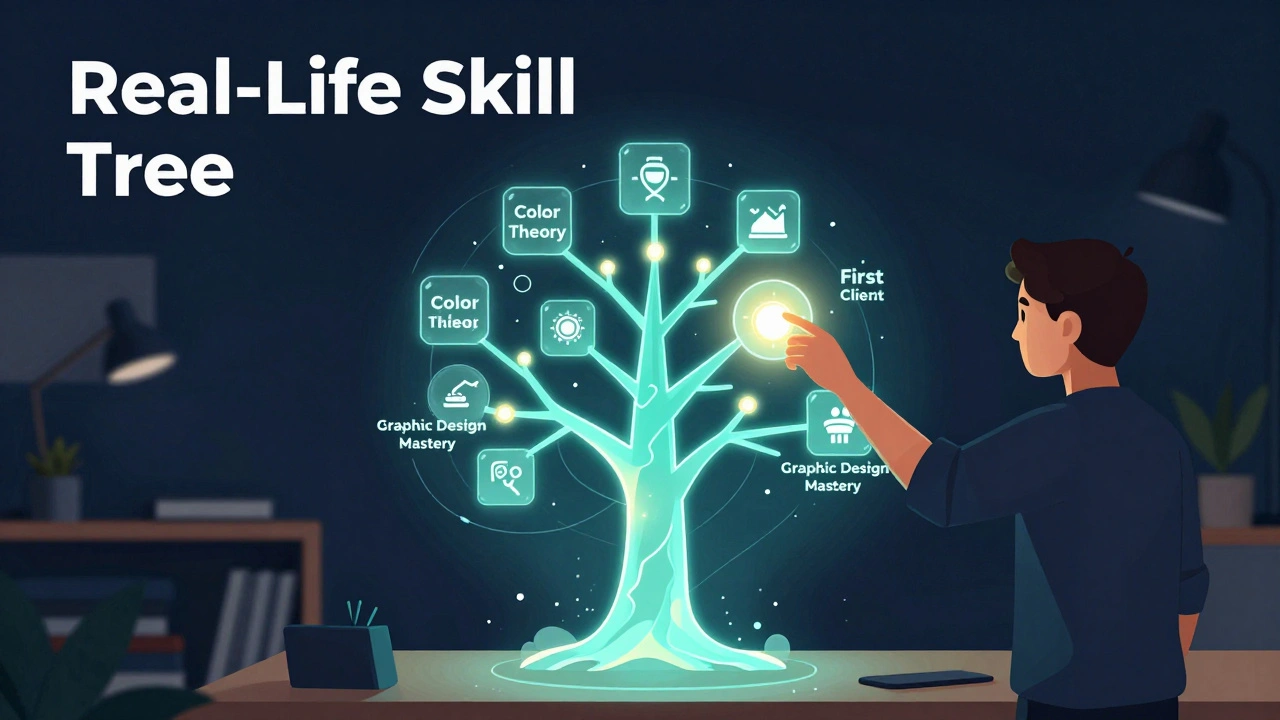
Think of your dreams not as a destination, but as a skill tree in an RPG. You can't jump straight to "Master Architect" or "Professional Developer" without unlocking the prerequisite skills. When you set a goal like "I want to be fit," it's too vague. It's like saying "I want to beat the final boss" without knowing how to move your character.
Instead, build a concrete roadmap. If your dream is to start a freelance graphic design business, your skill tree looks like this:
- Basic Tools: Learn the interface of Adobe Photoshop or Figma. (Value: 10 hours of practice)
- Foundations: Understand color theory and typography. (Value: 5 completed tutorials)
- First Quest: Create three fake logos for imaginary companies.
- XP Gain: Find one friend who needs a logo and do it for free to get a real testimonial.
By treating your life as a series of unlocked achievements, you stop missing the game because you're playing a more interesting one: your own life.
The Strategy of Habit Replacement
You cannot simply "stop" a habit; you can only replace it. If you just delete your games but don't fill that time with something meaningful, you'll experience a void. This void is where boredom and depression live, and they will eventually pull you back to the console.
Use the "If/Then" logic used in programming. Instead of saying "I'll stop gaming," tell yourself: "If I feel the urge to launch a game, then I will do 10 pushups or read two pages of my book." This redirects the neural pathway. You're taking the energy of the craving and channeling it into a productive action.
| Feature | Digital Reward (Gaming) | Real-World Reward (Productive Goals) |
|---|---|---|
| Speed | Instant (seconds) | Delayed (days/months) |
| Effort | Repetitive/Grinding | Cognitive/Physical Growth |
| Permanence | Lost if server closes | Permanent skill/asset |
| Social Value | Niche/Community specific | Universal professional value |
Managing the "Withdrawal" Phase
The first 14 to 21 days are the hardest. You'll likely feel a sense of irritability or a lack of purpose. This is essentially a Dopamine Detox, where your brain is recalibrating its sensitivity to pleasure. When you remove the super-stimulus of high-end gaming, normal things-like a sunset or a conversation-start to feel rewarding again.
During this phase, avoid "digital substitutes." Many people quit gaming only to spend 8 hours a day scrolling through TikTok or YouTube. This is just trading one dopamine loop for another. To actually recover, you need a period of boredom. Boredom is the fertile soil where creativity and ambition grow. If you're never bored, you'll never feel the internal itch to build something real.
Building a Support System
Isolation is a gamer's best friend and a recovering addict's worst enemy. Most of us use games to satisfy a need for social connection. When you quit, you lose your guild, your squad, and your daily chat. You must replace this social circle with people who are pursuing their own dreams.
Join a local gym, a coding club, or a book circle. Find people whose "status symbols" aren't rare items, but things like a completed marathon, a published article, or a new certification. When you surround yourself with people who value growth, the desire to spend 12 hours on a raid starts to seem illogical.

Measuring Progress Without a HUD
One of the biggest challenges is the lack of a Heads-Up Display (HUD) in real life. You don't have a progress bar over your head telling you how close you are to the next level. You have to build your own tracking system.
Use a physical journal or a simple spreadsheet. Track your "streaks." For example, if you're learning to code, track how many days in a row you've written at least one line of logic. Seeing a 30-day streak of green checkmarks triggers the same psychological reward as a leveling-up sound effect in a game. It provides the visual proof that you are evolving.
Can I still play games occasionally while pursuing my goals?
Yes, but not until you've established your new identity. If you've spent years using gaming as an escape, your brain has a very strong "autopilot" toward it. It's better to go completely cold turkey for 30 to 90 days to reset your dopamine receptors. Once your productive goals are habits-meaning you do them without thinking-you can introduce gaming as a timed reward (e.g., 2 hours on Saturday) rather than a daily necessity.
What if I feel like my real-life goals are too boring compared to games?
That's normal. Games are engineered to be more exciting than reality. The trick is to find a "bridge" activity. If you love strategy games, try learning chess or stock trading. If you love combat and action, try Brazilian Jiu-Jitsu or boxing. Find a real-world equivalent that shares the same core appeal as your favorite genre. The physical exertion and risk of real-world activities provide a natural rush that digital games can't replicate.
How do I deal with the guilt of wasted years spent gaming?
Guilt is a productivity killer. Instead of viewing those years as "wasted," view them as a study in systems. You've learned how motivation works, how to persist through failure, and how to master complex systems. The only difference is the medium. Take that level of dedication and apply it to your career or health. The "grind mindset" is a superpower if you point it in the right direction.
How do I stop the urge to check gaming news or forums?
Digital triggers are just as dangerous as the games themselves. Unfollow gaming influencers, leave the Discord servers, and turn off notifications for gaming apps. When you see a new trailer or a patch note, it re-activates the craving. Create a "digital sanctuary" where your feed is only filled with content related to your new goals-whether that's fitness, art, or business.
What is the first step I should take today?
Start with an "Audit of Time." For three days, track every hour you spend gaming. Be honest about the number. Then, look at that number and realize that if you spent even half of that time on a specific skill, you'd be in the top 10% of the population in that field within a year. That realization is often the spark needed to move from dreaming to doing.
Next Steps for Your Recovery
If you're feeling overwhelmed, start with a "Low-Stimulus Sunday." Spend one full day without screens. No phone, no PC, no console. Walk, read, and write down exactly who you want to be in five years. When the noise of the digital world stops, your actual dreams become audible. From there, pick one skill and commit to 30 minutes of daily practice. The goal isn't perfection; it's just to prove to yourself that you can control the controller of your own life.