
You took the IGD test. You got a score. Now you are staring at a number, wondering if it means anything real or if you are just overthinking it. Here is the truth: Internet Gaming Disorder (IGD) is not diagnosed by a single magic number, but specific cutoff scores act as red flags that tell you where you stand on the spectrum of risk. If your score is low, you might be fine. If it is high, you might need to change your habits. But what happens in between? That is where things get messy.
This guide breaks down exactly what those numbers mean. We will look at how different tests calculate risk, why context matters more than the raw score, and what you should actually do with the result. No jargon, no fluff-just clear answers so you can stop guessing and start acting.
What Is Internet Gaming Disorder?
Before we talk about scores, let's make sure we agree on what we are measuring. Internet Gaming Disorder is a condition recognized by the DSM-5 (Diagnostic and Statistical Manual of Mental Disorders) as a condition for further study. It is not yet a full official diagnosis like depression or anxiety, but clinicians use its criteria to identify problematic behavior.
The core idea isn't just "I play a lot." Plenty of people game for hours without being disordered. The disorder is defined by impairment. Are you neglecting hygiene? Are you lying about your playtime? Do you feel irritable when you cannot log off? These behavioral markers are what the tests measure. The score you get is simply a quantification of how many of these symptoms you experience and how intense they are.
Think of it like blood pressure. A reading of 120/80 is normal. 140/90 is elevated. 180/120 is a crisis. The IGD test works similarly, giving you a numerical range that correlates with clinical severity.
The Most Common IGD Screening Tools
There is no single "IGD Test." Instead, researchers and therapists use several validated questionnaires. Knowing which one you took changes how you interpret your score. The two most widely used tools are the Gaming Addiction Scale (GAS) and the Internet Gaming Disorder Scale-Short Form (IGDS-SF).
The GAS was developed by Lemmens et al. in 2009. It asks nine questions based on the DSM-IV criteria for addiction, such as tolerance, withdrawal, and conflict. Each question is rated on a five-point scale from "Never" to "Very Often." The total score ranges from 9 to 45.
The IGDS-SF, often associated with Pontes et al., aligns more closely with the DSM-5 criteria. It uses a similar Likert scale structure but focuses specifically on internet-based gaming contexts. While both tools measure similar constructs, their scoring algorithms differ slightly. Always check which version you used. If you took an online quiz labeled "IGD Test," it is likely a simplified adaptation of one of these scales.
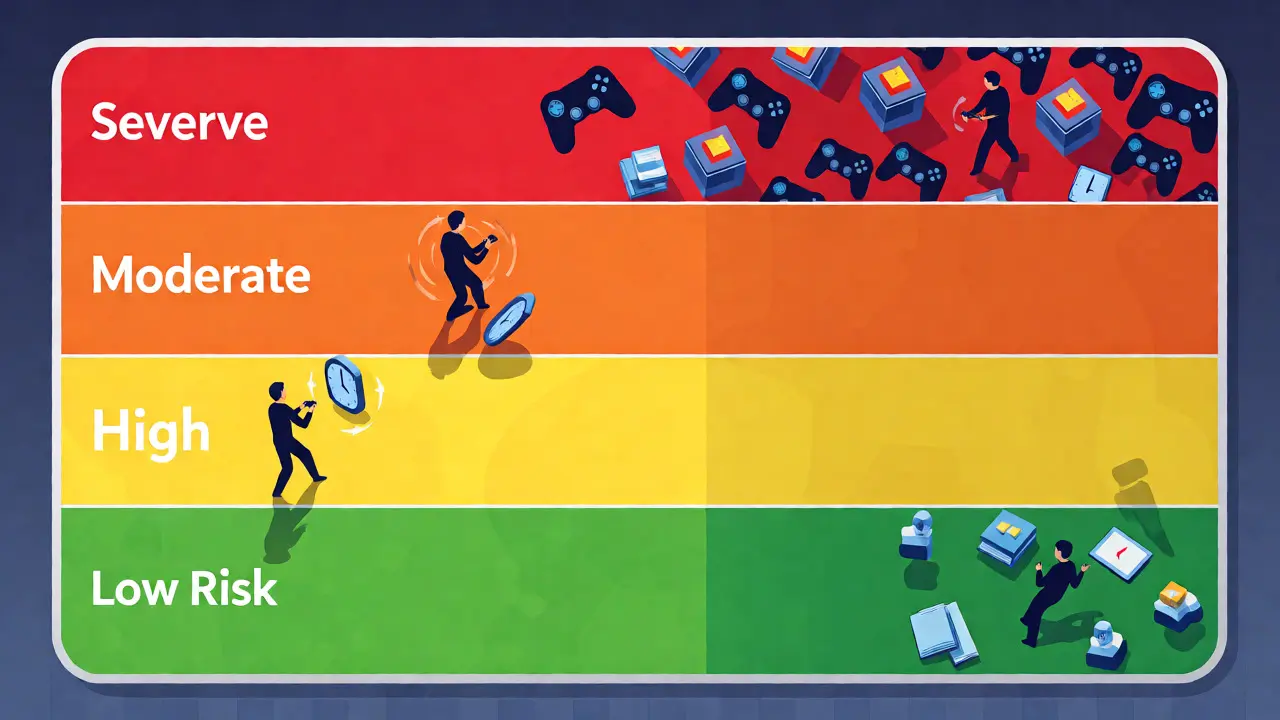
Decoding Your Score: What Indicates Risk?
This is the part everyone wants. What number equals "problematic"? Because there is no universal standard, we rely on research benchmarks. Generally, higher scores indicate higher risk. However, the definition of "high" varies by population (students vs. adults) and culture.
For the Gaming Addiction Scale (GAS), here is a general breakdown:
- 9-18: Low risk. You enjoy gaming, but it does not control your life. This is typical recreational play.
- 19-26: Moderate risk. You may experience occasional conflicts or neglect responsibilities, but you still have control. This is the "watch zone."
- 27-35: High risk. Significant impairment is likely present. You probably struggle to cut back despite negative consequences.
- 36-45: Severe risk. This score strongly suggests pathological behavior. Professional intervention is often recommended.
For the IGDS-SF, studies often use percentile ranks rather than fixed numbers because cultural norms vary. However, a common heuristic is that scoring above the 75th percentile of your peer group indicates potential disorder. In absolute terms, if you consistently answer "Often" or "Very Often" to questions about withdrawal and failure to reduce play, you are in the high-risk category regardless of the exact sum.
| Score Range (GAS) | Risk Level | Typical Behavior | Recommended Action |
|---|---|---|---|
| 9-18 | Low | Casual play, no interference with daily life | Maintain current habits |
| 19-26 | Moderate | Occasional guilt, minor sleep loss | Self-monitoring, set limits |
| 27-35 | High | Chronic procrastination, social isolation | Behavioral adjustments, counseling |
| 36-45 | Severe | Job/school loss, physical health decline | Professional therapy |
Why Context Matters More Than the Number
A score of 30 for a college student during finals week looks very different from a score of 30 for a working parent. Context changes everything. During exam periods, stress levels rise, and gaming often becomes a coping mechanism. A temporary spike in your score might reflect situational stress rather than a chronic disorder.
Consider your baseline. Have you always played this much? Or did your usage jump recently? A sudden increase in score is a stronger indicator of developing problems than a chronically high score that has remained stable for years. Stability suggests adaptation; volatility suggests loss of control.
Also, consider the type of game. MMORPGs (Massively Multiplayer Online Role-Playing Games) and loot-box-heavy mobile games are designed with variable reward schedules that mimic slot machines. These genres tend to produce higher IGD scores naturally due to their addictive mechanics. If you play a casual puzzle game once a day, a moderate score might be less concerning than if you play a competitive shooter for six hours straight.

False Positives and False Negatives
Can you fail the test even if you don't have a problem? Yes. Can you pass it while struggling? Also yes.
False positives happen when other mental health issues mimic IGD symptoms. For example, someone with ADHD might score high on "difficulty concentrating on tasks other than gaming" and "restlessness when unable to play." These are symptoms of ADHD, not necessarily primary gaming addiction. Similarly, depression can lead to escapism through gaming, resulting in a high IGD score that is actually secondary to the mood disorder.
False negatives occur when individuals minimize their symptoms. Denial is a powerful filter. If you answer honestly, the test works. If you subconsciously underreport how often you lie to family members about your playtime, your score will be artificially low. Remember, self-reporting relies entirely on your honesty. If you find yourself debating whether an answer is "Sometimes" or "Often," lean toward the higher frequency. Erring on the side of caution is better than ignoring a growing problem.
Next Steps Based on Your Score
So, you have your number. What now? Don't panic. A high score is not a life sentence; it is data. Use it to make informed decisions.
If you scored in the Low Risk range, keep doing what you are doing. Monitor your habits occasionally, especially during stressful times. You are likely engaging in healthy leisure activity.
If you scored in the Moderate Risk range, try a self-experiment. Set strict time limits for two weeks. Use app timers or parental controls. Track how you feel when the timer goes off. If you can stop easily, you are in good shape. If you feel intense anger or anxiety, your risk level is higher than the score suggested. Consider speaking with a therapist who specializes in behavioral addictions.
If you scored in the High or Severe Risk range, professional help is the best path. Look for cognitive-behavioral therapy (CBT), which has shown strong results in treating gaming disorders. You don't need to quit gaming forever. The goal is to regain control so that gaming enhances your life rather than dominating it.
Is there a definitive medical test for IGD?
No. There is no blood test or brain scan that definitively diagnoses Internet Gaming Disorder. Diagnosis is clinical, based on patient history, symptom duration (usually 12 months), and functional impairment. Questionnaires like the GAS or IGDS-SF are screening tools, not diagnostic instruments.
Do I need to meet all criteria to be considered at risk?
Not necessarily. The DSM-5 requires meeting at least five of nine criteria for a diagnosis. However, screening tests weigh symptoms differently. A very high intensity in just three or four key areas (like withdrawal and conflict) can result in a high risk score, indicating significant impairment even if you don't meet every single criterion.
Can kids take these IGD tests?
Yes, but interpretation differs. Children and adolescents have different social and developmental baselines. Parents and educators should use age-specific versions of these scales. A score that seems high for an adult might be typical for a teenager navigating complex social dynamics through online gaming. Always consult a pediatrician or child psychologist for minors.
How long does it take to lower my IGD score?
This varies by individual. Behavioral changes can show results in 4-6 weeks of consistent effort. Therapy may take 3-6 months to address underlying causes like anxiety or depression. Retesting after a month of modified habits can provide a clearer picture of progress.
Are online IGD quizzes accurate?
It depends on the source. Quizzes based on validated scales like the GAS or IGDS-SF are reasonably reliable for screening purposes. However, random online quizzes created by bloggers or marketing sites may lack scientific validation. Always check if the quiz cites a published study or established psychological scale.