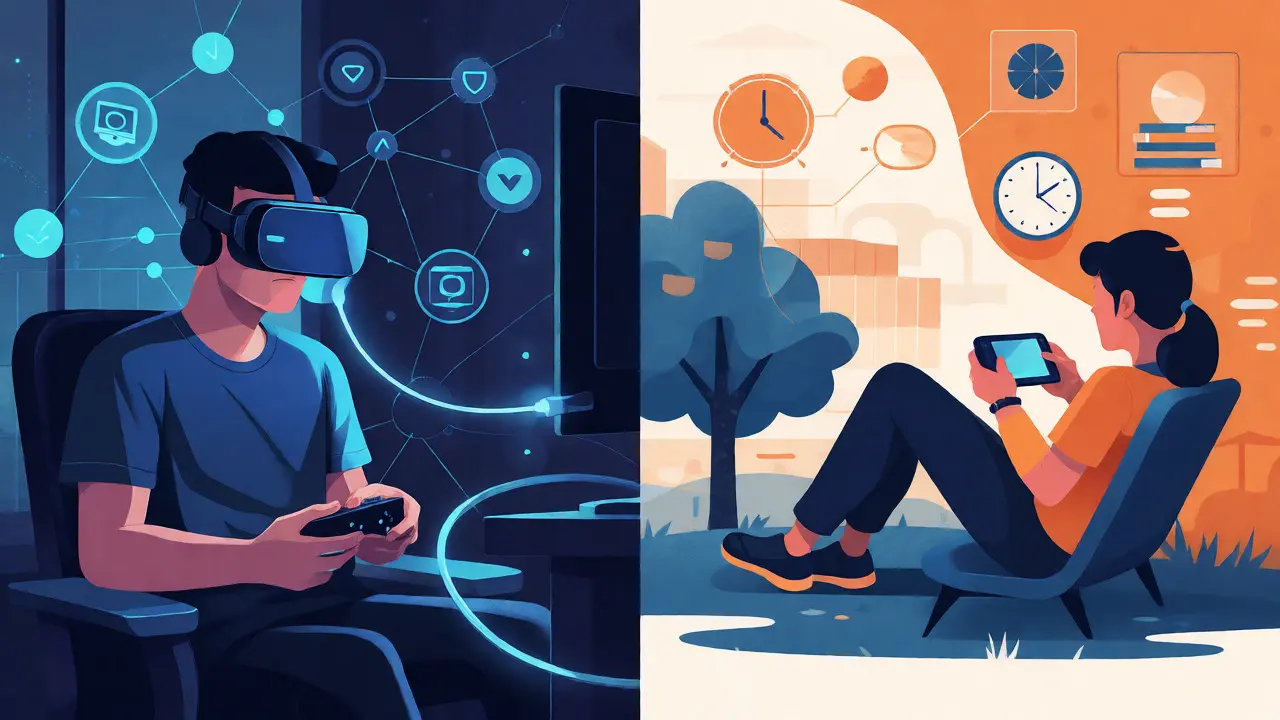
You’ve probably heard someone say they’re "addicted to gaming," but did you know there are actually two different official diagnoses for this? One comes from the American Psychiatric Association’s DSM-5-TR, which calls it Internet Gaming Disorder. The other comes from the World Health Organization’s ICD-11, which labels it simply Gaming Disorder. They sound similar, right? But if you’re trying to get help, insurance coverage, or just understand what’s happening in your brain, the difference matters. A lot.
Here’s the thing: these aren’t just semantic nitpicks by academics. The way a condition is defined changes how doctors treat it, how researchers study it, and whether your health plan pays for therapy. In September 2026, with VR headsets becoming mainstream and mobile gaming eating up more hours than ever, understanding these distinctions is crucial for gamers, parents, and clinicians alike. Let’s break down exactly where they differ, why it happened, and what it means for you.
The Core Difference: Online vs. Offline
The biggest hurdle people hit when comparing these two is the scope of behavior each diagnosis covers. It’s not just about name changes; it’s about what counts as the problem.
Internet Gaming Disorder (IGD) is a condition listed in Section III of the DSM-5-TR (the text revision of the Diagnostic and Statistical Manual of Mental Disorders). It is currently classified as a "condition for further study." This means the APA acknowledges it’s real enough to track, but they haven’t fully committed to calling it a standalone disorder yet. Crucially, IGD focuses specifically on persistent and recurrent use of the internet to engage in games, often with other players. If you play single-player offline console games for eight hours a day but never go online, you technically don’t fit the strict definition of IGD under the DSM framework.
On the flip side, Gaming Disorder is an official mental health diagnosis in the ICD-11 (International Classification of Diseases), which went into effect in January 2022. The WHO dropped the word "internet" entirely. Why? Because research showed that the core issue isn’t the connection-it’s the loss of control over gaming itself, regardless of the platform. Whether you’re grinding levels on a Switch, playing a massive multiplayer online role-playing game (MMORPG) like World of Warcraft, or using a cloud-streaming service, the behavioral pattern is what triggers the diagnosis.
This shift reflects a broader scientific consensus: the medium doesn’t matter; the compulsion does. By removing the "internet" qualifier, the ICD-11 captures a wider range of problematic behaviors, including those involving offline digital games or even traditional games if the digital component is primary.
Clinical Criteria Side-by-Side
Both systems agree on the basics: impaired control, increasing priority given to gaming, and continuation despite negative consequences. But the execution differs. Here is how they stack up against each other in practice.
| Feature | DSM-5-TR (Internet Gaming Disorder) | ICD-11 (Gaming Disorder) |
|---|---|---|
| Status | Condition for Further Study (Section III) | Official Diagnosis (Chapter 06) |
| Platform Scope | Primarily internet-based gaming | Digital or analog gaming (focus on digital) |
| Timeframe | Not explicitly defined in criteria, usually implied 12 months | Symptoms must be evident for at least 12 months |
| Severity Threshold | Requires 5 out of 9 proposed criteria | Requires all three core components present |
| Exclusion Criteria | Must not be better explained by another mental disorder | Must not be attributable to another medical condition or substance use |
The DSM-5-TR uses a checklist approach. You need to exhibit five specific behaviors, such as withdrawal symptoms, tolerance (needing more time to feel satisfied), or giving up other interests. It’s quantitative. The ICD-11, however, looks for a qualitative pattern of dysfunction across three domains: impaired control over gaming, increasing priority of gaming over other life interests, and continuation or escalation of gaming despite the occurrence of negative consequences. It’s less about counting checkboxes and more about assessing the impact on daily functioning.

Why the DSM Hesitates While the ICD Commits
You might wonder why the American Psychiatric Association hasn’t officially added Gaming Disorder to the main list of disorders like Depression or Anxiety. It’s largely due to caution regarding comorbidity. Many individuals diagnosed with potential gaming issues also suffer from ADHD, depression, or social anxiety. Critics argue that gaming is often a symptom of these underlying conditions rather than a primary cause. The DSM committee wants robust longitudinal studies proving that gaming causes distress independent of other factors before granting full diagnostic status.
The WHO, conversely, operates globally. Their mandate includes helping countries allocate resources and standardize treatment codes. Without an official code in the ICD, hospitals and insurers worldwide struggle to bill for treatment or track epidemiological data. By adding Gaming Disorder to the ICD-11, the WHO prioritized clinical utility and global consistency over the APA’s stricter evidentiary bar for causality.
Think of it this way: The DSM asks, "Is this definitely its own disease?" The ICD asks, "Do we need a code to treat this effectively right now?" For a patient in Portland seeking therapy today, the ICD-11 code exists, making it easier for therapists to document cases and for international research to compare results.
Impact on Treatment and Insurance Coverage
If you’re looking for professional help, the distinction affects your wallet. In the United States, many insurance providers rely on DSM codes for reimbursement. Since Internet Gaming Disorder is still in the "further study" section, some insurers may deny claims for specialized gaming addiction therapy, categorizing it instead under general behavioral issues or co-occurring disorders like depression. However, this landscape is shifting. As more states adopt ICD-11 coding standards or recognize the validity of behavioral addictions, access to covered care improves.
Conversely, countries that have adopted ICD-11 earlier, such as Japan and South Korea, already have established public health frameworks for Gaming Disorder. Clinicians there can diagnose it directly, leading to clearer treatment pathways. If you travel or move internationally, your diagnosis might carry more weight in one system than the other.
Regardless of the label, effective treatment remains similar. Cognitive Behavioral Therapy (CBT) is the gold standard. It helps patients identify triggers-like boredom or social isolation-and develop coping mechanisms. Family therapy is also critical, especially for adolescents, since family dynamics often reinforce gaming habits. Medication isn’t typically used for the addiction itself but may address underlying conditions like ADHD or anxiety that drive the excessive play.

Common Misconceptions About Gaming Addiction
Let’s clear up some myths. First, high volume of play does not equal addiction. Professional esports athletes play 10-14 hours a day. Are they addicted? No, because they maintain control, prioritize their career, and function well socially and physically. Addiction requires significant impairment in personal, family, social, educational, or occupational areas.
Second, not all "screen time" is gaming. Social media scrolling, binge-watching Netflix, or doom-scrolling news feeds share similarities with gaming loops but are distinct behaviors. While they can contribute to overall digital fatigue, they don’t fall under the specific criteria for Gaming Disorder unless the primary activity is interactive gameplay.
Third, gender stereotypes persist. Historically, gaming addiction was viewed as a male-dominated issue. Recent data shows that women are increasingly affected, particularly in mobile and casual gaming sectors. Titles like Candy Crush or Genshin Impact create powerful reward loops that affect all demographics equally. Ignoring female gamers delays diagnosis and support.
How to Self-Assess Your Risk
Are you or someone you know showing signs of problematic gaming? Use this quick checklist derived from both DSM and ICD guidelines. Answer honestly:
- Loss of Control: Do you find yourself playing longer than intended, even after saying "just one more match"?
- Neglect of Responsibilities: Have chores, work deadlines, or school assignments slipped because of gaming?
- Withdrawal Symptoms: Do you feel irritable, anxious, or sad when you cannot play?
- Tolerance: Do you need to spend more time gaming to get the same level of satisfaction?
- Continuation Despite Harm: Do you keep playing even though it’s causing arguments, sleep deprivation, or financial strain?
If you checked yes to most of these, and it has persisted for more than 12 months, it’s worth consulting a mental health professional. Early intervention prevents the habit from solidifying into a severe disorder.
Is Gaming Disorder considered a serious mental illness?
Yes, it is recognized as a clinically significant behavioral pattern. While it may not always require hospitalization, it can severely impact quality of life, relationships, and employment. It is treated similarly to other impulse-control disorders.
Can I be diagnosed with both Internet Gaming Disorder and Gaming Disorder?
Technically, no, because they describe the same underlying phenomenon using different classification systems. A clinician will choose the relevant code based on their region and insurance requirements. They are mutually exclusive labels for the same set of symptoms.
Does playing mobile games count toward Gaming Disorder?
Absolutely. The ICD-11 definition covers digital gaming on any device, including smartphones and tablets. The key factor is the compulsive nature of the play and the negative impact on daily life, not the hardware used.
What is the main difference between DSM-5-TR and ICD-11 regarding gaming?
The DSM-5-TR lists "Internet Gaming Disorder" as a condition for further study and focuses on online play. The ICD-11 lists "Gaming Disorder" as an official diagnosis and includes both online and offline digital gaming, emphasizing loss of control and functional impairment.
Is gaming addiction caused by dopamine?
Partially. Video games trigger dopamine release through reward systems (leveling up, winning). Over time, the brain may adapt, requiring more stimulation to achieve the same pleasure (tolerance). However, psychological factors like escapism and social connection are equally important drivers.