
You sit down to play a game for an hour. Three hours later, you realize you haven't moved from the chair, but your mind feels more exhausted than when you started. You weren't just playing; you were running on a treadmill of thoughts. This is where rumination and video gaming collide in a way that often goes unnoticed until it hurts.
Rumination isn't just "thinking." It's repetitive, passive dwelling on negative feelings and their causes without moving toward action. Video games, especially immersive ones, offer a perfect container for this loop. They provide immediate feedback and clear goals, which contrasts sharply with the messy ambiguity of real life. But here’s the twist: instead of stopping the rumination, gaming can sometimes amplify it by allowing the brain to disengage from external reality while remaining hyper-engaged internally.
The Mechanics of the Mental Loop
To understand why this happens, we need to look at how the brain processes unresolved stress. When you are ruminating, your default mode network (DMN) is highly active. The DMN is the brain system responsible for self-referential thought-thinking about yourself, your past, and your future. Normally, engaging in a demanding task like solving a puzzle or fighting a boss suppresses the DMN because it requires focused attention.
However, many modern games are designed with "flow" states in mind, where difficulty matches skill perfectly. In these states, you might feel present, but if the gameplay becomes too automatic-think farming resources in an RPG or grinding levels-the conscious mind checks out. What fills that void? Often, it's the very thoughts you tried to escape. You're physically in Azeroth or Hyrule, but mentally, you're replaying an argument from work or worrying about a bill. The game becomes background noise to your internal monologue.
| Cognitive State | Brain Activity | Emotional Outcome | Role of Rumination |
|---|---|---|---|
| Active Engagement | High executive function, low DMN | Satisfaction, Flow | Suppressed effectively |
| Passive Grinding | Low executive function, high DMN | Numbness, Anxiety | Amplified; thoughts run wild |
| Avoidant Play | Dissociative focus | Temporary relief, then guilt | Masked, not resolved |
Why Games Are the Perfect Host for Rumination
Video games are uniquely suited to host ruminative loops because they lack the social friction of other activities. If you go for a walk or talk to a friend, external inputs interrupt your train of thought. A game, particularly single-player titles, creates a closed ecosystem. You control the input. This autonomy feels safe, but it removes the natural brakes on obsessive thinking.
Consider the concept of escapism. We often view escapism as negative, but it serves a function. It gives the brain a break from high-stakes decision-making. The problem arises when escapism becomes avoidance. Instead of processing emotions, you park them. The game world offers predictable outcomes-you press X, you jump. Real life doesn't have a jump button. When you return to reality after a long session, the contrast between the game's clarity and life's chaos can trigger a fresh wave of rumination about how "out of control" things feel.
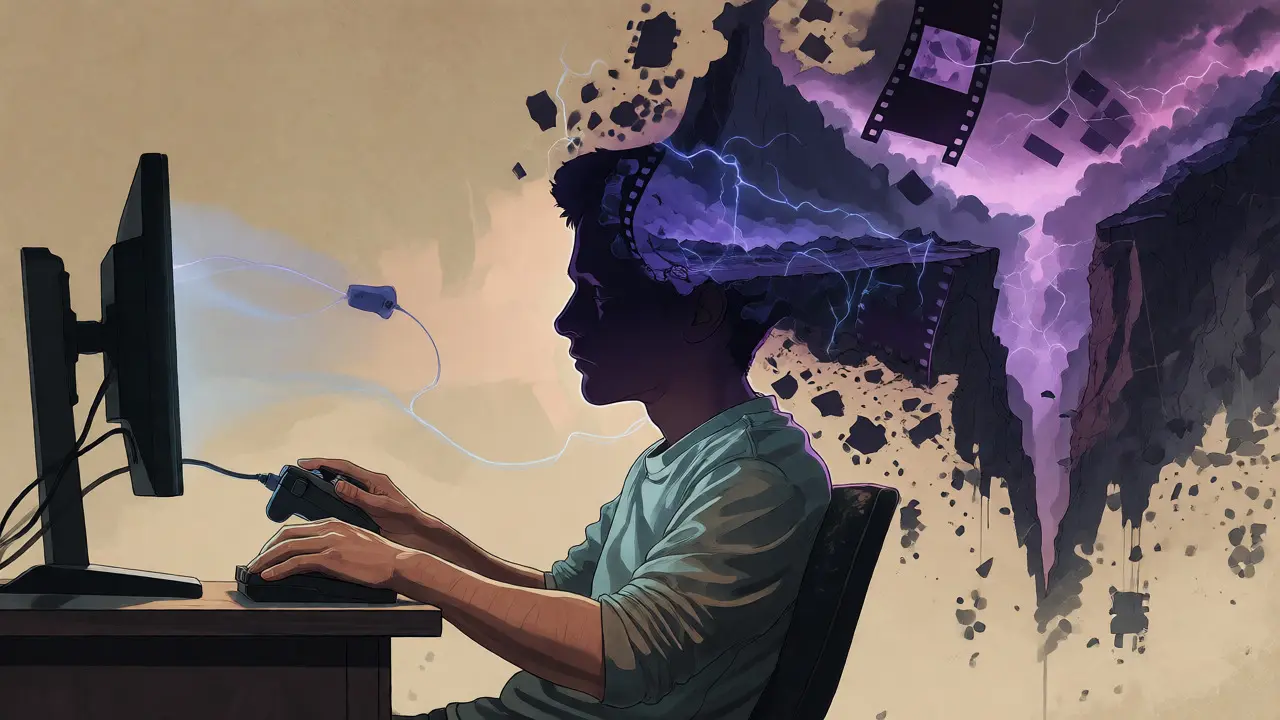
Identifying the Signs
How do you know if your gaming is feeding rumination rather than relieving it? Look for these specific patterns:
- The Guilt Spiral: You finish a gaming session feeling worse than before, yet you immediately queue up another match to "fix" the feeling.
- Automaticity: You don't remember what happened in the last hour of play. Your hands knew what to do, but your mind was elsewhere.
- Physical Tension: Despite sitting still, you experience jaw clenching, shallow breathing, or headaches associated with stress, not excitement.
- Narrative Projection: You find yourself identifying heavily with characters who are also stuck in cycles of failure or revenge, mirroring your own internal state.
It’s not about the amount of time spent playing. Someone can play for ten minutes and enter a deep ruminative state, while another person plays for five hours in a state of pure flow. The key differentiator is awareness. Are you watching the screen, or are you using the screen as a backdrop for your worries?
Breaking the Cycle: Practical Strategies
You don't need to quit gaming to stop ruminating. In fact, banning games can increase stress, leading to more rumination. The goal is to change how you play.
1. The Timer Trick
Set a visible timer for your gaming sessions. When it goes off, pause the game. Don't just close the lid. Sit there for sixty seconds. Ask yourself: "What am I feeling right now?" This brief interruption breaks the hypnotic quality of the loop. It forces the DMN to acknowledge the transition back to reality.
2. Choose High-Engagement Genres
If you notice you tend to zone out, switch genres. Fast-paced competitive shooters or complex strategy games require constant decision-making. These genres leave less room for the mind to wander into negative loops compared to open-world exploration games or idle clickers, which are prone to inducing passive rumination.
3. Pair Gaming with Physical Grounding
Try playing while standing at a desk or holding a light weight. Engaging your proprioceptive sense (the sense of body position) helps anchor you in the physical present. This makes it harder for the mind to drift entirely into abstract worry.
4. Journal Before and After
Spend two minutes writing down what you intend to get out of the session. Afterward, write one sentence about how you actually feel. This practice builds metacognition-the ability to think about your thinking. Over time, you'll spot the triggers that send you into a ruminative spiral.

The Role of Dopamine and Reward Systems
Gaming exploits our dopamine reward pathways. Every loot box, level-up, or kill provides a micro-dose of satisfaction. For someone prone to rumination, these quick hits can become addictive not because they are pleasurable, but because they temporarily silence the critical inner voice. This is known as negative reinforcement-you play to remove discomfort, not necessarily to gain joy.
Research suggests that individuals with high trait anxiety or depression are more likely to use digital media for mood regulation. If you rely on gaming solely to quiet your mind, you risk developing a tolerance. Soon, you need longer sessions to achieve the same numbing effect, which further disconnects you from the actions needed to solve the underlying problems causing the stress.
Beyond the Screen: Integrating Insights
Once you recognize the pattern, you can use gaming data as a diagnostic tool. Notice which games correlate with higher rumination. Is it the story-heavy narrative games that make you reflect on your own unfinished business? Or is it the endless grind that mirrors your feeling of working hard without progress?
Treat your gaming habits as a mirror. If you find yourself avoiding difficult conversations by logging in, that’s a signal. The game isn't the enemy; the avoidance is. By bringing mindfulness to your playtime, you transform gaming from a hiding place into a restorative activity. You can enjoy the virtual world without letting it consume your mental bandwidth.
Remember, breaking the mental loop takes time. Be patient with yourself. Start small. One mindful session is better than a week of unconscious grinding. The goal isn't perfection; it's presence.
Is all video gaming bad for mental health?
No. Research indicates that moderate gaming can improve cognitive flexibility, reaction times, and even social connection through multiplayer environments. The issue arises specifically when gaming is used as a primary coping mechanism for unresolved emotional distress, leading to passive engagement and increased rumination.
What is the difference between immersion and rumination?
Immersion involves being fully absorbed in the current task, often resulting in a 'flow' state where time seems to disappear but satisfaction remains high. Rumination is a passive, repetitive focus on negative thoughts or feelings. While both involve losing track of time, immersion leaves you energized, whereas rumination leaves you drained and anxious.
Can certain types of games cause more rumination?
Games with low mechanical complexity and high atmospheric depth, such as idle games, simple farming simulators, or open-world explorers with minimal pressure, are more likely to induce passive states conducive to rumination. Conversely, fast-paced competitive games or complex puzzles demand active cognitive resources, leaving less mental space for negative thought loops.
How does sleep affect the rumination-gaming cycle?
Sleep deprivation impairs the prefrontal cortex, which regulates emotions and impulse control. When tired, you are more susceptible to ruminative thoughts and less able to resist the urge to game for comfort. This creates a vicious cycle where late-night gaming disrupts sleep, leading to poorer emotional regulation the next day.
Should I quit gaming if I struggle with rumination?
Not necessarily. Abrupt cessation can lead to withdrawal symptoms and increased stress. Instead, try modifying your habits: set strict time limits, choose more engaging genres, and practice mindfulness during breaks. If gaming continues to interfere with daily functioning despite these changes, consulting a mental health professional may be beneficial.