
Quick Takeaways
- Social anxiety often drives people toward gaming as a low-risk way to socialize.
- The "safe" environment of a game can lead to avoidance of real-world social growth.
- Gaming addiction usually starts as a coping mechanism for emotional distress.
- Recovery requires addressing the underlying anxiety, not just limiting screen time.
When we talk about Social Anxiety Disorder, we aren't talking about being shy. Social Anxiety Disorder (SAD) is a mental health condition characterized by intense fear of social situations and a persistent worry about being judged by others. This fear creates a massive barrier in the real world. In a physical office or a classroom, the stakes feel incredibly high. One wrong word can lead to hours of ruminating. In a virtual world, however, the rules change. You can mute people, leave a chat instantly, or hide behind a curated avatar.
The Allure of the Virtual Safe Haven
Why do games attract people who struggle with social interaction? It comes down to controlled exposure. In a game, social interactions are often structured. You aren't just "talking"; you are "completing a quest" or "defending a base." This shared goal provides a script, reducing the unpredictability that makes real-life conversations terrifying.
Consider MMORPGs (Massively Multiplayer Online Role-Playing Games). MMORPGs are online games that feature persistent virtual worlds populated by many players simultaneously. In these spaces, a player can experience a sense of belonging and status that they lack in their physical life. If you're an outcast at school but the guild leader of a 40-person raid group in World of Warcraft, the dopamine hit is massive. The game doesn't just provide entertainment; it provides a functional identity.
When Coping Becomes a Compulsion
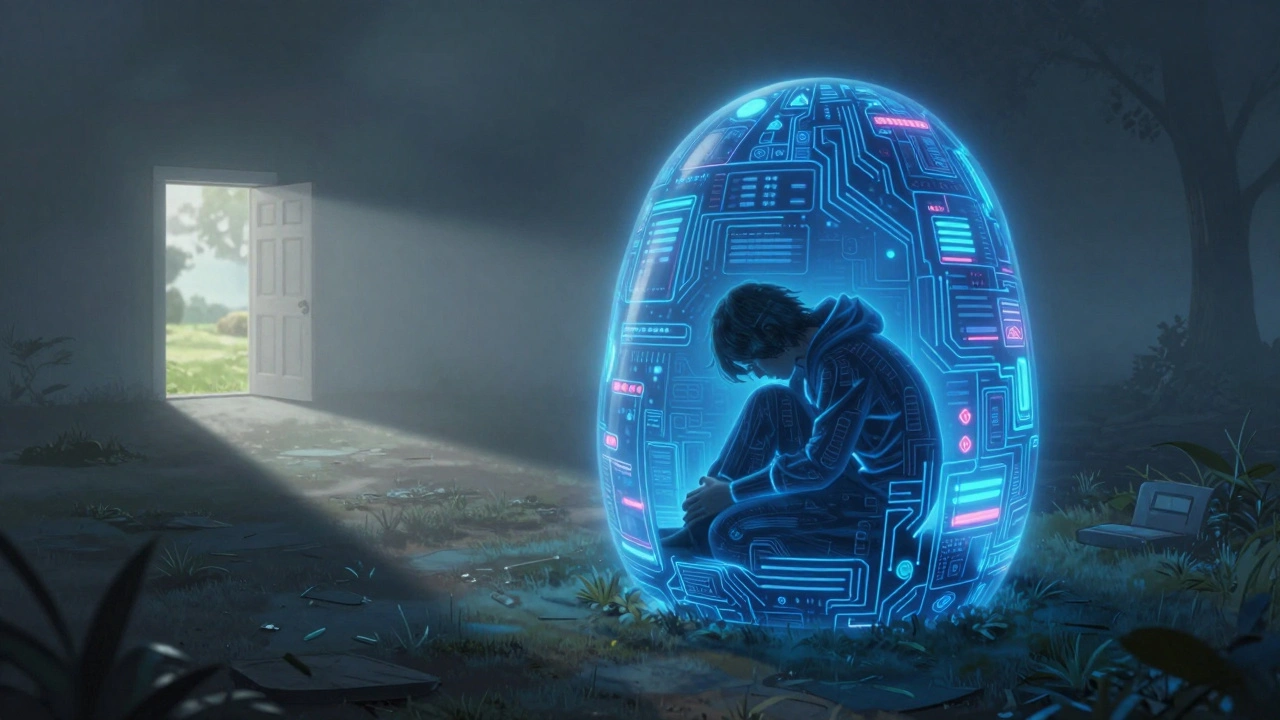
The transition from "using a game to relax" to a full-blown addiction happens when gaming stops being a tool and starts being a requirement. This is often where Escapism enters the picture. Escapism is the tendency to seek distraction and relief from unpleasant realities, especially by imagining better circumstances. For someone with social anxiety, the real world is the "unpleasant reality."
When the brain realizes that gaming removes the pain of anxiety, it creates a powerful feedback loop. The more you avoid the real world, the more terrifying the real world becomes. This is called "avoidance reinforcement." Every hour spent in a game is an hour you didn't have to face a panic attack, but it's also an hour you didn't spend learning how to manage that anxiety. Eventually, the person may develop Internet Gaming Disorder, which is recognized by the World Health Organization as a pattern of gaming behavior characterized by impaired control over gaming and prioritizing gaming over other life interests.
| Feature | Real-World Socializing | Virtual-World Socializing |
|---|---|---|
| Risk Level | High (Unpredictable) | Low (Controllable) |
| Feedback | Nuanced/Non-verbal | Direct/Text-based |
| Identity | Fixed/Authentic | Flexible/Curated |
| Exit Strategy | Difficult (Social norms) | Instant (Alt+F4 / Log out) |
The Dopamine Trap and Reward Systems
Gaming is designed to be addictive. Developers use Variable Reward Schedules-the same logic used in slot machines-to keep players engaged. Variable reward schedules are a pattern of reinforcement where a reward is given after an unpredictable number of responses. For a person with social anxiety, who rarely gets "rewards" (like praise or a new friend) in real life, these digital wins are intoxicating.
When you level up or find a rare item, your brain releases dopamine. For someone whose daily life is a struggle against anxiety, this chemical surge is a lifeline. The danger is that the brain begins to prefer these artificial rewards over the slow, difficult process of building real-life relationships. This leads to a state where the person isn't just playing for fun; they are playing to avoid the crushing weight of their own mental health struggles.
Identifying the Red Flags
It can be hard to tell the difference between a passionate gamer and someone struggling with an addiction. The key is the impact on "global functioning." Are they failing classes? Have they stopped showering? Do they get angry when they have to stop playing?
A common sign is the "substitution effect." This happens when a person replaces all their real-world social needs with digital ones. While they might say, "I have plenty of friends online," those relationships often lack the depth and emotional support provided by physical presence. If the only reason someone plays is to avoid a specific fear-like going to a party or starting a new job-the gaming is no longer a hobby; it's a symptom.
Breaking the Cycle: Path to Recovery
You can't fix a gaming addiction by just taking away the console. If the person is gaming to escape social anxiety, removing the game leaves them alone with the very anxiety that drove them to the screen in the first place. This often leads to severe depression or an even more desperate search for a new escape.
The gold standard for treating this combination is Cognitive Behavioral Therapy. Cognitive Behavioral Therapy (CBT) is a psychological treatment that helps people identify and change destructive thought patterns that lead to challenging behaviors. Specifically, "exposure therapy" is used to help people face their social fears in small, manageable doses. Instead of jumping into a crowded party, a patient might start by making eye contact with a cashier or calling a friend on the phone.
The goal is to build "social efficacy"-the belief that you can handle a social interaction, even if it's uncomfortable. Once a person feels competent in the real world, the lure of the virtual world diminishes because it is no longer the only place they feel successful.
Is all gaming a risk for people with social anxiety?
No. For many, gaming is a healthy way to wind down or find community. It becomes a risk when it is used as the only way to socialize or as a tool to avoid necessary real-life responsibilities. The difference lies in whether the gaming enhances your life or replaces it.
Can online friends actually help reduce social anxiety?
In some cases, yes. For people with severe anxiety, online communities can act as "training wheels," allowing them to practice communication and build confidence in a lower-pressure environment. However, this only helps if the person eventually tries to bridge those skills into real-world settings.
What is the first step to stop gaming addiction?
The first step is acknowledging the why. If you realize you're gaming to hide from fear, the most effective path is seeking a therapist who specializes in anxiety. Combining game-time limits with a plan to face social fears is much more effective than a "cold turkey" approach.
Does the type of game matter in terms of addiction risk?
Yes, games with persistent worlds (MMORPGs) or competitive rankings (like League of Legends or Valorant) tend to be more addictive because they create social obligations and a desire for status, which are particularly appealing to those who feel invisible in real life.
How do I help a family member who is gaming to escape anxiety?
Avoid shaming them for their gaming habits, as this often increases their anxiety and pushes them further into the game. Instead, express concern for their wellbeing and offer support in finding a mental health professional. Focus on the anxiety, not the screen time.
Next Steps and Troubleshooting
If you find yourself in this cycle, start by tracking your triggers. Do you reach for the controller the moment you have to think about a social event? Identifying this pattern is the first step toward breaking it. Try a "micro-challenge" today: send one text to a real-life acquaintance or spend five minutes in a public space without a device. If the thought of this causes a panic attack, it's a clear sign that professional help is needed.
For parents, the most important thing is to maintain a connection with the gamer. If the game is their only source of validation, you must find ways to provide that validation in the real world. Praise their efforts in small social wins, not just their achievements in the game. Remember, the addiction is the shield they've built; don't take away the shield until you've helped them find the strength to stand without it.