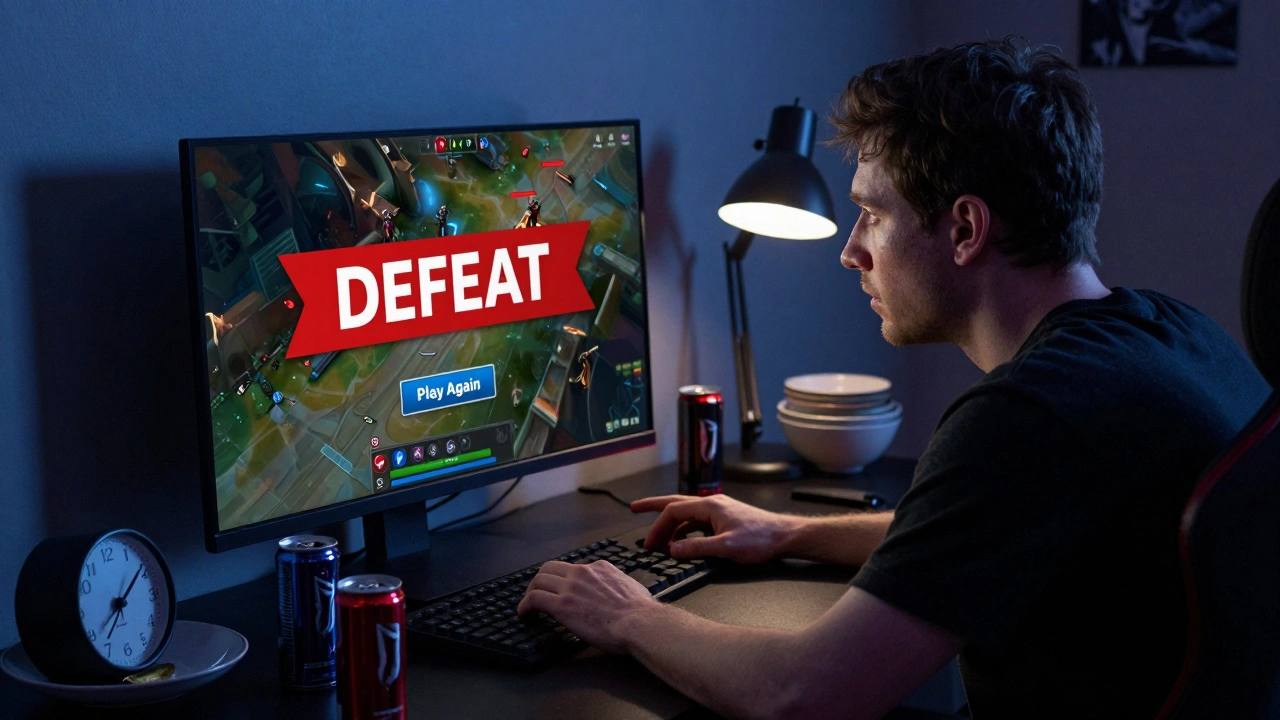
Have you ever lost a match in a competitive game-say, a close match in League of Legends or a tight race in Call of Duty-and immediately hit "Play Again" without even taking a breath? You tell yourself it’s just one more game. Then another. And another. Two hours later, you’re exhausted, frustrated, and still not closer to winning. You didn’t win. You didn’t even break even. But you can’t stop. This isn’t just about being competitive. This is loss chasing.
What Is Loss Chasing in Gaming?
Loss chasing in gaming is when you keep playing after a defeat, not to improve or have fun, but to undo the feeling of losing. It’s not about skill. It’s about emotion. You’re trying to erase a negative experience by forcing a positive one. Sound familiar? It’s the same psychological pattern seen in gambling addiction: you lose money, so you gamble again to win it back. In games, you lose a match, so you play again to "fix" it.
Studies from the University of Cambridge in 2023 tracked over 1,200 competitive gamers and found that 37% of those who lost a ranked match would play at least three more games in the same session, regardless of time, fatigue, or real-life obligations. The higher the stakes-like climbing a ranked ladder or defending a win streak-the stronger the urge to replay.
Why Your Brain Keeps Pushing You Back In
Your brain doesn’t treat digital losses like real ones. When you lose a game, your body releases cortisol-the stress hormone. At the same time, your dopamine system, which rewards wins, goes silent. That imbalance creates a craving. You don’t just want to win the next game. You need to win the next game. It’s not about the trophy. It’s about silencing the internal noise of failure.
Games are designed to exploit this. Randomized rewards, near-misses, and variable feedback loops (like a last-second clutch kill or a comeback win) trick your brain into thinking the next game is "just one more" away from redemption. It’s called the "near-miss effect." You almost won. So you try again. And again. And again.
In Valorant, a player who loses a round by one HP will often replay the same map 5-7 times in a row, convinced they "know how to do it now." But they never improve. They just repeat the same mistakes, hoping the outcome changes. That’s not strategy. That’s compulsion.
The Hidden Cost of Compulsive Rematch Behavior
It’s easy to brush off. "It’s just a game," people say. But the consequences are real.
- **Sleep disruption**: 68% of gamers who report daily loss chasing also report sleeping less than 6 hours on nights they played heavily.
- **Declining performance**: Players who chase losses show a 22% drop in win rate over time, not because they got worse-but because they stopped learning. They’re stuck in reactive mode, not improvement mode.
- **Emotional burnout**: Anger, irritability, and withdrawal from real-life relationships are common. One player from Portland told researchers, "I missed my sister’s birthday because I was stuck on rank 12 in Apex. I didn’t even notice until the next morning."
- **Physical strain**: Wrist pain, eye fatigue, and poor posture from hours of repetitive play are now being documented in clinical settings. A 2025 study in the Journal of Sports Medicine linked chronic gaming sessions to early-onset carpal tunnel in players under 25.
How to Break the Cycle
Stopping isn’t about willpower. It’s about restructuring habits. Here’s what actually works:
- Set a hard loss limit. Decide before you play: "If I lose 2 matches in a row, I stop." Not "I’ll play one more." Not "I’ll just check my rank." A hard limit creates a boundary your brain can respect.
- Use a timer. Set a 45-minute session limit. When it ends, you walk away-even if you’re in the middle of a match. Apps like Freedom or Screen Time can enforce this automatically.
- Replace the urge. When you feel the pull to rematch, do something physical. Walk around the block. Do 10 push-ups. Splash cold water on your face. Movement resets your nervous system better than any game.
- Track your wins and losses. Keep a simple log: Win/Loss. After a week, look at the pattern. You’ll see that most "must-win" matches don’t change your overall record. That’s eye-opening.
- Play with others who quit. Find a friend who also struggles with this. Make a pact: "If one of us loses twice, we both log off and text each other a meme." Accountability works better than solo discipline.

When It’s More Than Just a Bad Habit
Not every player who replays after a loss has an addiction. But if you recognize these signs, it might be time to seek help:
- You lie about how much time you spend playing.
- You’ve lost jobs, grades, or relationships because of gaming.
- You feel anxious, restless, or irritable when you can’t play.
- You’ve tried to cut back and failed multiple times.
These are signs of behavioral addiction. The American Psychiatric Association recognizes "Internet Gaming Disorder" as a condition for further study. It’s not officially a diagnosis yet-but it’s real. And it’s treatable.
Therapies like Cognitive Behavioral Therapy (CBT) have shown success in reducing compulsive gaming by 60% in clinical trials. The goal isn’t to quit games. It’s to regain control.
Games Shouldn’t Control You
Competitive games are meant to be fun, challenging, and social. They’re not meant to be emotional traps. The thrill of victory is real. But so is the pain of defeat. And that pain shouldn’t force you back into the arena.
You don’t owe yourself a win after a loss. You owe yourself rest. You owe yourself your time. You owe yourself the chance to walk away without guilt.
Next time you lose, pause. Breathe. Ask yourself: "Am I playing to win… or just to feel better?"
Is chasing losses in games a form of addiction?
Yes, in some cases. While not everyone who replays after a loss has an addiction, persistent loss chasing-especially when it leads to sleep loss, declining performance, or emotional distress-matches the behavioral patterns of addiction. The American Psychiatric Association lists "Internet Gaming Disorder" as a condition under study, and loss chasing is one of its key indicators.
Why do I feel worse after winning a rematch?
Because winning after a loss doesn’t fix the emotional damage-it just temporarily masks it. The relief is short-lived because the underlying issue-the fear of failure, the need for control-remains. True healing comes from breaking the cycle, not from winning the next game.
Do all competitive games encourage loss chasing?
Not all, but many do. Games with ranked systems, leaderboards, and variable rewards (like League of Legends, Valorant, Apex Legends, and Counter-Strike) are especially prone to encouraging this behavior. They use psychological triggers-near-misses, streaks, and uncertainty-to keep players hooked. Simpler games without progression systems rarely cause this.
Can I still play competitively without chasing losses?
Absolutely. Many top players have strict routines: one session per day, no replays after losses, and clear mental boundaries. Competitive gaming doesn’t require obsession. It requires discipline. The best players know when to walk away-and they use that discipline to stay sharp, not burned out.
What should I do if I can’t stop on my own?
Talk to a therapist trained in behavioral addiction. Cognitive Behavioral Therapy (CBT) is especially effective for gaming-related compulsions. Many online services offer remote sessions. You don’t need to be "broken" to seek help. You just need to care enough about your well-being to try.
Loss chasing isn’t a weakness. It’s a system designed to trap you. The good news? You’re already aware. That’s the first step to breaking free.