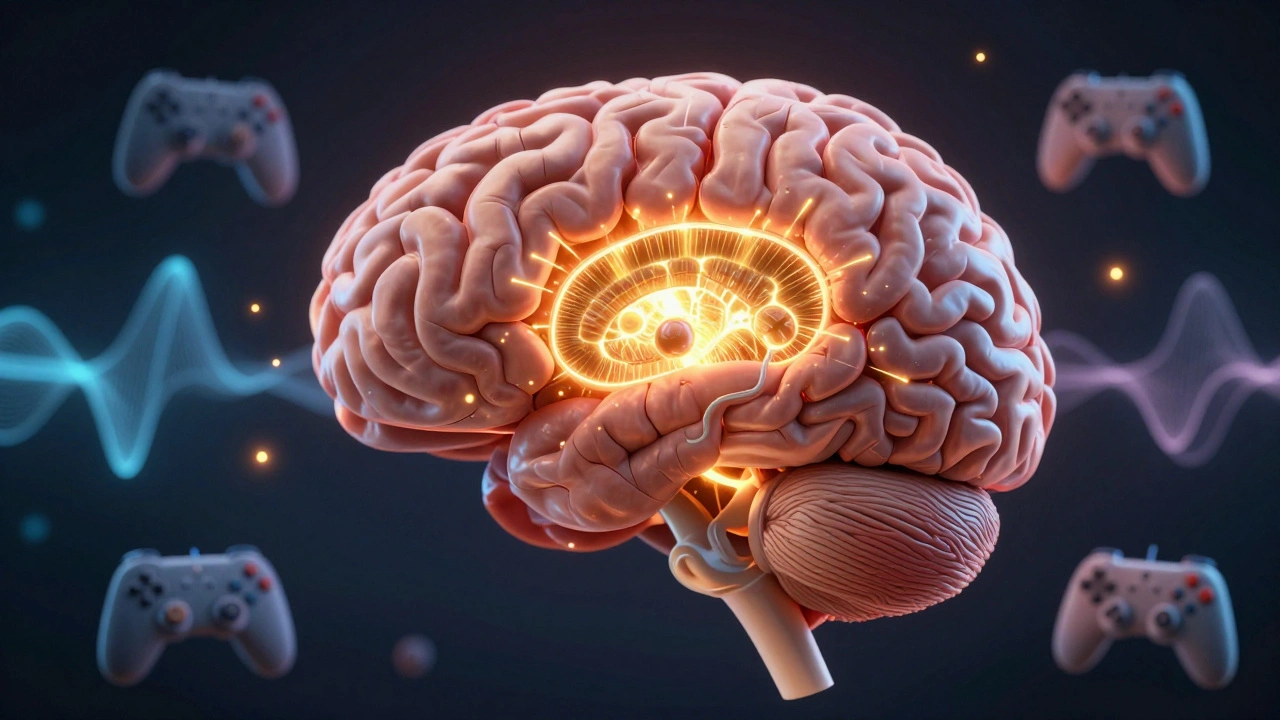
When a 14-year-old spends five hours straight playing a multiplayer game, it’s not just about being "addicted to fun." It’s about what’s happening inside their brain - and why that makes them far more vulnerable than an adult would be. The teenage brain isn’t just a smaller version of an adult’s. It’s a work in progress, and gaming can hijack its natural development in ways that are hard to reverse.
The Teen Brain Is Wired for Reward, Not Consequences
The prefrontal cortex - the part of the brain responsible for decision-making, impulse control, and weighing long-term consequences - doesn’t fully mature until around age 25. Meanwhile, the brain’s reward system, centered on the nucleus accumbens and fueled by dopamine, is hyperactive during adolescence. This isn’t a bug. It’s evolution. Teenagers are meant to explore, take risks, and form social bonds. But in today’s digital world, video games exploit this biology perfectly.
Every kill, every level-up, every loot drop triggers a surge of dopamine. It’s not just satisfying - it’s addictive. A 2023 study from the University of Oregon tracked 1,200 teens over two years and found that those who played competitive online games for more than three hours daily had a 68% higher chance of developing compulsive gaming behaviors compared to peers who played under one hour. The difference wasn’t about the game genre - it was about how often their brains got hit with that reward spike.
Gaming Isn’t the Problem. The Pattern Is.
Not every teen who plays games becomes addicted. But when gaming becomes the primary way to escape stress, feel competent, or connect with others, the risk spikes. For teens with anxiety, depression, or social isolation, games offer something real: control, achievement, and belonging. A 15-year-old who feels invisible at school might become a legendary player in an online team. That feeling is powerful. And when the game shuts off, the crash is brutal.
Researchers at Stanford’s Center for Digital Health found that teens who used gaming as their main coping mechanism were four times more likely to develop symptoms of gaming disorder within six months. It’s not the game itself. It’s what the game replaces. If a teen isn’t getting enough sleep, meaningful friendships, or physical activity, gaming fills the void - and then becomes the only thing that feels good.
How Gaming Rewires the Brain Over Time
Neuroimaging studies show that chronic, heavy gaming in teens leads to structural changes. The gray matter in the prefrontal cortex thins out, while the striatum - the brain’s habit center - grows denser. Think of it like this: the part that says "stop" gets weaker, and the part that says "do it again" gets stronger.
A 2025 meta-analysis of 17 brain scan studies found that teens with gaming addiction had a 19% reduction in prefrontal cortex volume compared to non-addicted peers. That’s not just a number. It means slower reaction times, worse emotional regulation, and less ability to resist urges. And here’s the kicker: these changes start showing up after as little as six months of daily play exceeding four hours.
It’s not that games are evil. It’s that the brain doesn’t distinguish between a dopamine hit from a win in a game and one from food, sex, or social praise. When gaming becomes the easiest, most reliable source of that hit, the brain stops seeking other rewards. Social skills atrophy. Motivation for school fades. Sleep gets pushed back. And the cycle tightens.

Signs You’re Dealing With More Than Just "Lots of Gaming"
How do you tell the difference between a kid who loves games and one who’s slipping into addiction? Look for these patterns:
- They lie about how long they play - or hide their screen time.
- School performance drops sharply, even in subjects they used to enjoy.
- They get irritable, anxious, or angry when asked to stop playing.
- They’ve quit or lost interest in sports, hobbies, or friends outside gaming.
- They play through the night, then crash in class or skip school.
The DSM-5-TR classifies gaming disorder as a real condition when these behaviors last at least 12 months and cause major disruption in daily life. But you don’t have to wait that long. If you see three of these signs over three months, it’s time to act - not to take away the controller, but to understand the void it’s filling.
Why Parental Rules Alone Don’t Work
Setting screen time limits? Fine. But if you just block the game without addressing the underlying need, you’re not solving the problem - you’re creating resistance. Teens with gaming addiction aren’t lazy. They’re often highly intelligent, creative, and deeply sensitive. They’re using games because they work better than anything else in their life right now.
A 2024 clinical trial in Portland public schools tested two approaches: strict screen bans vs. structured replacement therapy. The group that got screen limits alone saw no change in behavior. The group that replaced gaming with weekly group activities - like rock climbing, art therapy, and peer-led coding clubs - saw a 62% drop in compulsive gaming symptoms in just four months. The key? They didn’t remove the escape. They gave them a better one.

What Actually Helps: Replacing the Void
Recovery from gaming addiction in teens isn’t about quitting games. It’s about rebuilding a life where games aren’t the only thing that feels good. Here’s what works:
- Find their passion outside screens. Whether it’s music, robotics, skateboarding, or volunteering - give them a space where they can feel mastery and belonging.
- Build real social connections. Group activities with low pressure (no teams, no rankings) help rebuild social confidence without the dopamine rollercoaster.
- Fix sleep first. Teens need 8-10 hours. Blue light and late-night gaming destroy melatonin. A strict 9 p.m. device curfew - not enforced by tech, but by routine - is the single most effective intervention.
- Get them moving. Just 30 minutes of daily physical activity boosts natural dopamine and serotonin. It doesn’t have to be sports. Walking, dancing, or even gardening helps.
- Listen, don’t lecture. Teens with gaming addiction often feel misunderstood. Ask: "What do you love about the game?" not "Why can’t you stop?"
There’s no magic number for "safe" gaming. But research suggests that teens who play under 90 minutes a day on school nights and no more than three hours on weekends rarely develop problems - as long as they’re getting enough sleep, movement, and real-world connection.
The Bigger Picture: A Generation at Risk
We’re not just talking about a few teens who play too much. We’re talking about a generation growing up with a tool designed to maximize engagement - and a brain that’s biologically primed to be hooked. The average teen today spends over 6 hours a day on screens. Gaming makes up nearly half of that. And with AI-driven games becoming more adaptive, the dopamine traps are getting smarter.
But this isn’t hopeless. The adolescent brain is also incredibly plastic. It can rewire. With the right support, teens can rebuild their reward system around real-life achievements, relationships, and challenges. It takes patience. It takes consistency. And it takes adults who understand that this isn’t about discipline - it’s about biology.
Can gaming addiction permanently damage a teen’s brain?
The changes seen in the prefrontal cortex and striatum during gaming addiction are reversible - but only if the behavior stops. Studies show that after six months of reduced gaming and increased real-world engagement, brain scans return to near-normal levels. The longer the addiction lasts, the harder it is to reverse. Early intervention is key.
Are some games more addictive than others?
Yes. Games with loot boxes, daily rewards, competitive leaderboards, and social pressure (like Fortnite, Apex Legends, or Genshin Impact) trigger the strongest dopamine responses. Single-player games with linear stories are far less likely to cause addiction. The issue isn’t the game genre - it’s the design that exploits intermittent reinforcement and social validation.
Is gaming addiction recognized as a real medical condition?
Yes. The World Health Organization included "Gaming Disorder" in the ICD-11 in 2018, and the American Psychiatric Association lists it in the DSM-5-TR as a condition for further study. It’s diagnosed when gaming causes severe impairment in personal, family, social, educational, or occupational functioning for at least 12 months.
Should I take away my teen’s gaming devices?
No. Removing devices without replacing the function of gaming usually backfires. Teens need to feel in control of their recovery. Instead, work with them to set boundaries, find alternatives, and rebuild routines. A collaborative approach reduces resistance and builds trust.
How long does it take for a teen to recover from gaming addiction?
Recovery varies. Most teens show improvement within 3-6 months of consistent lifestyle changes. Full recovery - where gaming no longer controls their emotions or choices - often takes 9-18 months. The key is not stopping gaming overnight, but slowly rebuilding a life where games are a hobby, not a necessity.