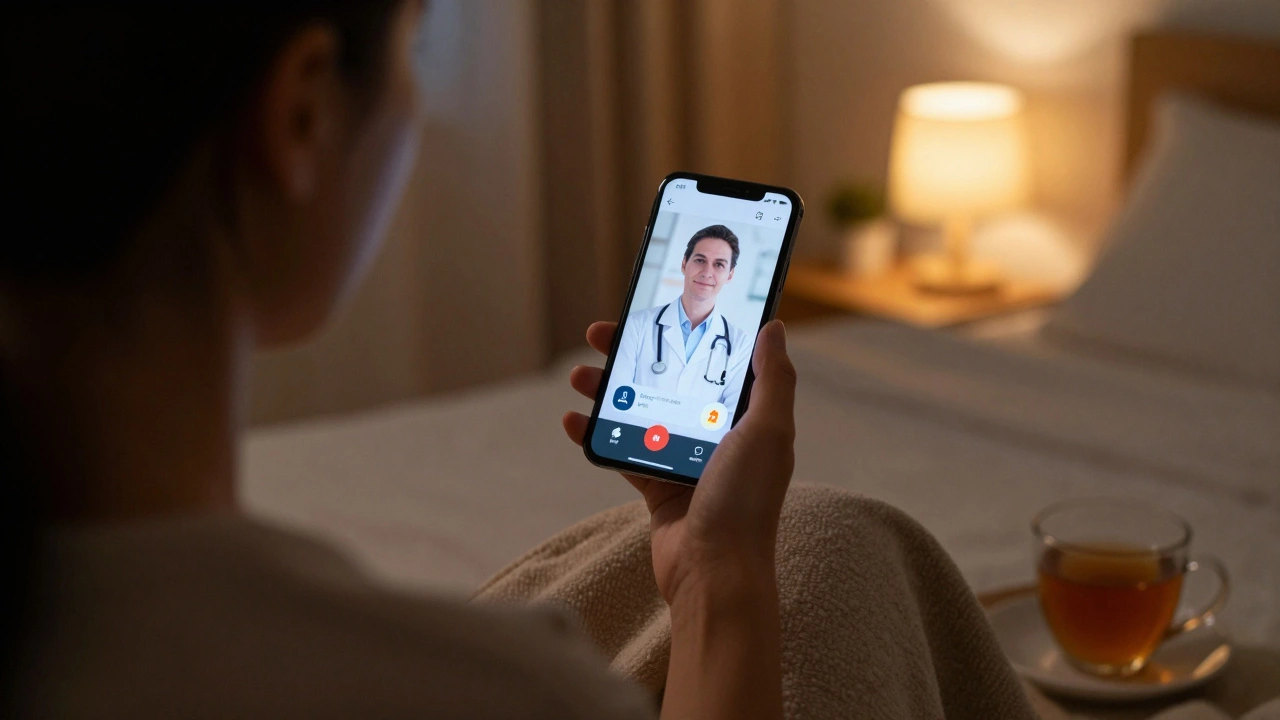
If you're feeling overwhelmed, panicky, or just can't cope right now, you don't have to wait weeks for a therapist. Telehealth urgent care for mental health is here - and it works when you need it most.
What Telehealth Urgent Care for Mental Health Actually Means
It’s not a fancy term. It’s simple: getting real-time mental health help over video, phone, or secure messaging when you’re in crisis. Think of it like going to an urgent care clinic, but instead of a sore throat, you’re dealing with panic attacks, suicidal thoughts, or sudden depression.
Unlike traditional therapy, which often requires scheduling weeks ahead, telehealth urgent care gives you access to licensed clinicians within hours - sometimes minutes. These aren’t chatbots. They’re real therapists, psychiatrists, or nurse practitioners who can assess your situation, offer immediate coping tools, and decide if you need higher-level care.
In 2025, over 4.2 million Americans used telehealth urgent care for mental health, according to data from the National Institute of Mental Health. That’s up 140% from just two years ago. Why? Because people are tired of waiting. And the system finally started listening.
When to Use It (And When Not To)
You should reach for telehealth urgent care when:
- You’re having a panic attack that won’t stop
- You’re feeling hopeless and can’t see a way out
- You’ve had a triggering event - breakup, job loss, death - and you’re spiraling
- You’re on medication and suddenly feel worse
- You’re in a crisis but not in immediate physical danger
It’s NOT for emergencies where you’re actively trying to harm yourself or others. If that’s the case, call 988 (the Suicide & Crisis Lifeline) or go to the nearest ER. Telehealth urgent care helps before things get that bad.
One Oregon woman, Sarah, told her story: “I started crying uncontrollably after my dad’s funeral. I couldn’t sleep, eat, or talk to anyone. I opened my insurance app and found a telehealth urgent care option. Within 20 minutes, I was talking to a therapist. She didn’t give me a pep talk. She gave me a breathing exercise, a safety plan, and a follow-up within 48 hours. That’s what saved me.”
How to Find a Telehealth Urgent Care Service
Not all mental health platforms offer urgent care. Here’s how to find one that does:
- Check your health insurance website. Most major insurers - Blue Cross, Kaiser, UnitedHealthcare - now include telehealth urgent care in their mental health coverage.
- Look for platforms that explicitly say “urgent care,” “same-day access,” or “crisis support.” Examples include Amwell, Teladoc Health, and Brightside.
- Use the 988 Suicide & Crisis Lifeline website. They have a directory of vetted telehealth providers who accept insurance and offer sliding-scale fees.
- Ask your primary care doctor. Many now have direct referrals to telehealth urgent care partners.
Pro tip: Don’t assume your current therapist can help in a crisis. Most only offer scheduled appointments. Urgent care services are built for emergencies.
What to Expect During Your Session
When you log in, you’ll usually be asked a few quick questions: your symptoms, how long they’ve lasted, and whether you’ve had thoughts of self-harm. This isn’t to scare you - it’s to match you with the right clinician.
Your session will last 15 to 30 minutes. The clinician won’t try to fix everything. Their job is to:
- Stabilize you - with breathing techniques, grounding exercises, or calming strategies
- Assess risk - are you safe right now?
- Give you a plan - what to do if it gets worse
- Connect you to follow-up care - whether that’s a weekly therapist, medication, or a support group
One common mistake people make: they expect a long therapy session. But urgent care isn’t about deep healing. It’s about stopping the fire before it spreads.
Cost and Insurance
Most insurance plans cover telehealth urgent care for mental health at the same rate as in-person visits. That means your copay might be $20-$50. If you’re uninsured, many providers offer sliding-scale fees based on income - some as low as $10 per session.
Medicaid and Medicare both cover these services in 2026. The federal government expanded access after the pandemic, and those rules are still in place.
Don’t let cost stop you. If you’re unsure, call the provider’s support line before booking. Ask: “Do you offer urgent care for mental health emergencies? What’s the cost if I’m uninsured?” They’ll tell you honestly.
Privacy and Safety
Your sessions are private. Everything you say is protected under HIPAA - the same law that keeps your medical records safe. Providers use encrypted video platforms, and no one records your session unless you give written permission.
Some people worry: “What if they call the police?” The answer: only if you’re actively planning to harm yourself or someone else. Otherwise, your words stay confidential. A therapist won’t report you for feeling sad. They’ll help you feel better.

What Comes After Urgent Care?
After your urgent care session, you’ll usually get a follow-up plan. This might include:
- A referral to a regular therapist for weekly sessions
- Medication evaluation with a psychiatrist
- Access to a peer support group
- A digital mood tracker to monitor progress
Don’t skip the follow-up. Urgent care is a bandage - not a cure. But it’s the bandage that lets you breathe long enough to start healing.
Real Stories, Real Results
Jamal, 28, from Atlanta, lost his job and fell into a depression. He tried calling his therapist - no availability for two weeks. He found a telehealth urgent care service through his employer’s health plan. He spoke to a clinician on a Tuesday at 8 p.m. By Thursday, he was on a low-dose antidepressant and had a weekly therapist lined up.
“I didn’t think I deserved help,” he said. “But that session told me I was worth it.”
And that’s the point. You don’t have to be “bad enough” to get help. You just have to be ready to reach out.
Final Thoughts: You’re Not Alone
Mental health emergencies don’t care if it’s 2 a.m. or if you’re in a small town with no therapists nearby. Telehealth urgent care bridges that gap. It’s fast, affordable, and confidential. And it’s available right now.
If you’re reading this and feeling shaky, scared, or stuck - take a breath. Open your phone. Go to your insurance portal. Search for “telehealth urgent care mental health.” You’ll find it. And you don’t have to wait.
Can I use telehealth urgent care for my child?
Yes. Many telehealth urgent care services offer pediatric mental health support. Providers specialize in working with teens and children, and parents can join the session if needed. Services like Talkspace and Cerebral have dedicated youth programs. Insurance typically covers these visits the same way as adult care.
Do I need a referral to use telehealth urgent care?
No. You can access these services directly through your insurance provider’s app or website. No doctor’s note or referral is required. Some employers also offer direct access through their wellness programs.
Is telehealth urgent care as effective as in-person care?
For crisis intervention, yes. Studies from the Journal of the American Medical Association (JAMA) show that telehealth urgent care for mental health is just as effective as in-person visits for reducing acute symptoms like panic, anxiety, and suicidal ideation. The key is speed - getting help fast matters more than the setting.
What if I don’t have a stable internet connection?
Most services offer phone-only options. You can call in and speak with a clinician without video. Some even offer text-based crisis support through secure messaging. If you’re in a low-connectivity area, call 988 - they can route you to a telehealth provider who can reach you by phone.
Can I get medication through telehealth urgent care?
Sometimes. Clinicians can prescribe short-term medications to stabilize you - like anti-anxiety pills or sleep aids. But long-term prescriptions usually require a follow-up with a psychiatrist. Urgent care isn’t meant to replace ongoing medication management, but it can be a bridge to it.