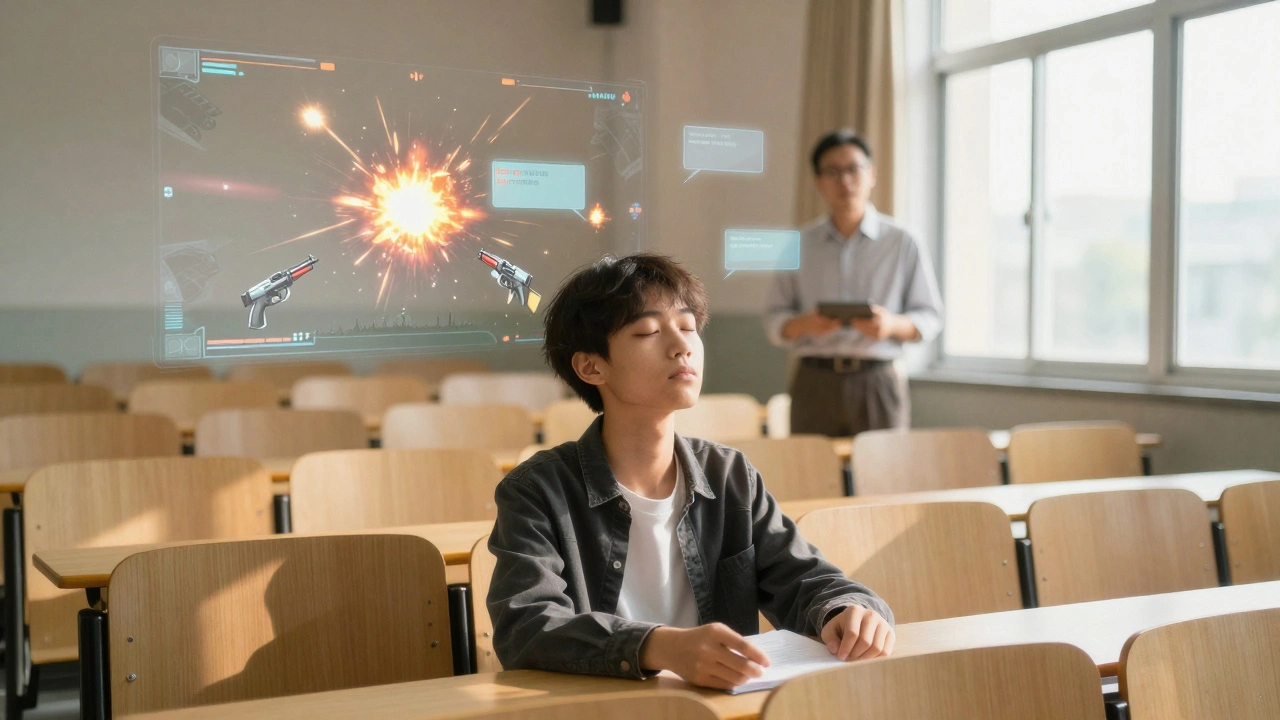
Picture this: you’re in a meeting, trying to follow the presentation, but your brain keeps replaying that last boss fight from last night’s game. Or you’re in class, the professor is explaining a key concept, and suddenly you’re mentally reloading your loadout, planning your next raid. These aren’t just distractions-they’re cognitive intrusions, and they’re a real symptom of gaming addiction.
What Exactly Are Intrusive Gaming Thoughts?
Intrusive gaming thoughts are unwanted, repetitive mental images, scenarios, or urges related to video games that pop up at inappropriate times. They’re not daydreams. They’re not harmless fantasies. They’re brain glitches-like a song you can’t get out of your head, but instead of music, it’s a respawn screen, a loot drop, or a chat message from your squad.
These thoughts aren’t just annoying. They interfere with your ability to concentrate, retain information, or even complete simple tasks. A 2023 study from the University of Oregon tracked 1,200 college students and found that those who reported frequent gaming intrusions scored 27% lower on attention tests during class hours. The more time spent gaming, especially in high-intensity, reward-driven environments like MMOs or battle royales, the more likely these thoughts become automatic.
Why Your Brain Gets Stuck on Gaming
Your brain is wired to chase rewards. Video games are designed to exploit this. Every kill, every level-up, every rare item drop triggers dopamine-the same chemical released by drugs, gambling, and binge-eating. Over time, your brain starts treating gaming as a primary source of satisfaction, not just entertainment.
When you stop playing, your brain doesn’t just shut off. It keeps running the game in the background. This is called involuntary mental rehearsal. It’s why you’ll find yourself mentally reloading your weapon while brushing your teeth or planning your next move while waiting in line. The brain’s default mode network, which usually handles daydreaming, gets hijacked by gaming patterns.
Unlike passive media like TV or YouTube, games are interactive. You’re not just watching-you’re making decisions, solving problems, feeling tension and release. That deep engagement makes it harder for your brain to switch gears. When you’re pulled away from the game, your mind tries to finish what it started. That’s why intrusive thoughts often hit hardest during breaks, transitions, or low-stimulus moments-like sitting in a lecture or waiting for your coffee to brew.
How Intrusive Thoughts Affect Work and School
At work, these thoughts can mean missed deadlines, poor decision-making, or even accidents. One warehouse worker in Portland reported nearly dropping a heavy box because he was mentally planning a team fight. At school, students with frequent gaming intrusions struggle with reading comprehension, test retention, and classroom participation.
It’s not just about attention span. It’s about cognitive load. Your brain is juggling two worlds: the real one you’re in, and the one you keep playing in your head. That mental tug-of-war drains your executive function-the part of your brain that plans, prioritizes, and controls impulses.
People who experience this often describe it as "mental fog." They feel tired, unfocused, and emotionally flat-even if they’ve been gaming for hours. That’s because gaming doesn’t rest your brain; it overloads it. You’re not relaxing-you’re working hard in a simulated environment, and your brain never fully disengages.

Signs You’re Beyond Normal Distraction
Everyone gets distracted. But here’s how to tell if it’s gone beyond normal:
- You replay game moments even when you’re not tired or bored
- You feel anxious or irritable when you can’t mentally access a game scenario
- You lose track of time during work or class because you’re mentally "in-game"
- You’ve tried to cut back on gaming, but the thoughts keep coming back
- Your performance at work or school has dropped noticeably
If you answer yes to three or more of these, you’re not just "into gaming." You’re experiencing a behavioral addiction pattern. The DSM-5-TR recognizes Internet Gaming Disorder as a condition warranting further study, and intrusive thoughts are one of its key diagnostic markers.
What to Do When Gaming Thoughts Take Over
Stopping gaming entirely isn’t always realistic-or necessary. But you need to break the cycle. Here’s what works:
- Use physical triggers-When you notice the thought, immediately do something that requires physical focus: stand up, stretch, drink water, or scribble on paper. This interrupts the mental loop.
- Replace, don’t suppress-Don’t try to force the thought away. Instead, replace it with a different mental image. Think of a calming place, a song you like, or a recent conversation. The brain can’t hold two competing images for long.
- Set boundaries around gaming-No gaming 90 minutes before work or school. No gaming after 11 p.m. These rules give your brain time to reset.
- Track your intrusions-Keep a simple log: time, situation, game title, how long the thought lasted. Awareness is the first step to control.
- Get movement-A 10-minute walk outside, even in winter, reduces intrusive thoughts by 40% in clinical trials. Nature resets your brain’s attention system.

When to Seek Help
If intrusive thoughts are affecting your job, grades, relationships, or sleep, it’s time to talk to a professional. A therapist trained in behavioral addictions can help you:
- Understand the root triggers
- Develop cognitive behavioral techniques to interrupt patterns
- Address underlying issues like anxiety, loneliness, or avoidance
There’s no shame in this. Addiction doesn’t mean you’re weak-it means your brain got stuck on a loop that was never meant to be this powerful. Millions of people struggle with this. Recovery isn’t about quitting gaming forever. It’s about regaining control over your attention.
Real-Life Example: Sarah’s Story
Sarah, 21, was a nursing student in Eugene. She played Valorant for 3-4 hours every night. Within weeks, she started thinking about aim training during anatomy lectures. She missed two quizzes because she was mentally rehearsing a match. Her GPA dropped from 3.8 to 3.1.
She started using the replacement technique: every time a game thought came up, she’d picture her grandmother’s garden. She set a 10 p.m. cutoff. She began walking to campus instead of driving. Within six weeks, her intrusive thoughts dropped by 80%. She didn’t quit gaming-she just stopped letting it run her brain.
Final Thought: Your Focus Is Yours to Take Back
Gaming is fun. It’s creative. It’s social. But when it starts running your thoughts during work or school, it’s no longer a hobby-it’s a takeover. You don’t have to give it up. You just have to reclaim your mind.
Are intrusive gaming thoughts a sign of addiction?
Yes, if they’re frequent, persistent, and interfere with daily responsibilities. The American Psychiatric Association recognizes repeated intrusive thoughts about gaming as a key symptom of Internet Gaming Disorder, especially when they occur during non-gaming hours and cause distress or impairment.
Can you have intrusive gaming thoughts without playing a lot?
Yes. It’s not always about hours played-it’s about intensity. A person who plays 1 hour a night in a highly immersive, reward-heavy game (like World of Warcraft or Apex Legends) can develop stronger intrusions than someone who plays 5 hours in a casual game. The brain responds to emotional intensity, not just time spent.
Do intrusive thoughts go away if you stop gaming?
Often, yes-but not always immediately. Studies show that intrusive thoughts can linger for weeks after quitting, especially if gaming was used to cope with stress or anxiety. The brain needs time to rewire. Using distraction techniques and replacing the mental habit helps speed up recovery.
Is this the same as OCD?
Not exactly. OCD involves unwanted thoughts that cause anxiety and lead to compulsive behaviors (like hand-washing). Gaming intrusions are more about habit loops and reward anticipation. They’re not usually accompanied by fear or ritual. But if you’re also doing repetitive behaviors to relieve the thoughts, it’s worth getting evaluated.
Can children and teens experience this too?
Absolutely. Teens are especially vulnerable because their prefrontal cortex-the part that controls impulses-is still developing. Schools have reported cases of students spacing out during tests because they’re mentally playing Fortnite. Parents should watch for declining grades, irritability when gaming is limited, and difficulty focusing on non-game tasks.